

The National Bird of Canada is the Canada Jay, a friendly and intelligent bird found in every province and territory.
This article explains why Canada finally chose a national bird, the full history behind the decision, and the facts that make the Canada Jay special.
You’ll learn about its scientific name, appearance, subspecies, cold-weather abilities, cultural importance, and the 2016–2025 selection process.
This guide gives you everything you need to know in one place.
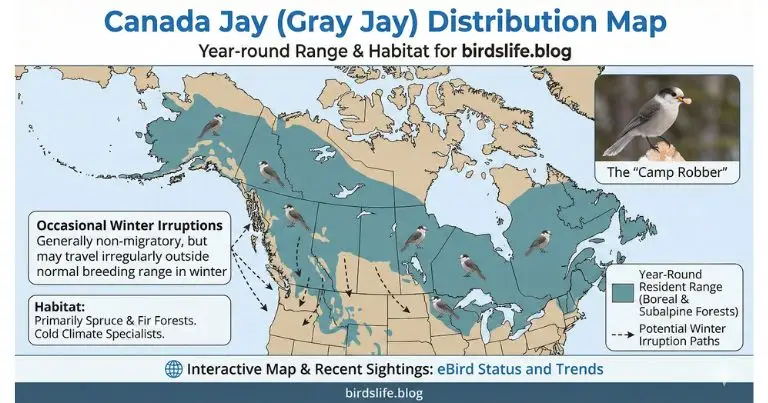
Canada Jay range map
The Canada Jay lives in boreal forests from Alaska across Canada to Newfoundland, extending into the mountainous and northern US states.
Table of Contents
Canada Jay range map
The Canada Jay lives in boreal forests from Alaska across Canada to Newfoundland, extending into the mountainous and northern US states.
Canada Jay Identification, Names, and Subspecies
Here you’ll find details about the Canada Jay’s scientific classification and names, what it looks like, and the nine subspecies found across Canada.
Scientific Classification and Official Names
The Canada Jay belongs to the Corvidae family, which includes crows, ravens, and magpies. Its scientific name is Perisoreus canadensis, from the Greek word “perisōreuō,” meaning “to heap up” or “bury beneath.” This fits the bird’s habit of storing food.
The bird’s common name has a long history. It was called the Canada Jay from the 1830s until 1957, when the American Ornithological Union changed it to “Gray Jay” to avoid confusion between subspecies.
This name lasted for over 60 years. On June 21, 2018, the American Ornithological Society voted to bring back the original name, Canada Jay.
Other Common Names:
- Gray Jay (or Grey Jay)
- Whiskey Jack (Whisky Jack)
- Mésangeai du Canada (French)
- Camp Robber
- Moose Bird
- Meat Bird
- Venison Hawk
- Lumberjack
- Gorby (or Gorby Bird)
Physical Description and Physiology
The Canada Jay is a medium-sized songbird with features that make it easy to spot in boreal forests.
- Size: 25–33 cm (10–13 inches) in length
- Weight: 60–92 g (2–3 ounces)
- Wingspan: 45–50 cm (18–20 inches)
- Appearance: It has soft, fluffy gray and white feathers that give it a distinct look.
Distinctive Features:
- Dark gray or brownish-gray upper parts (back and tail)
- White or pale gray underparts (chest and belly)
- White face with a darker gray or black cap and nape (back of head)
- Short, strong black bill adapted for prying loose bark and carrying food
- Dark eye line that gives the bird a gentle, intelligent look.
Adaptations for Extreme Cold:
One thing that makes the Canada Jay special is its thick plumage. The bird has loose, fluffy feathers that trap a lot of air, providing insulation similar to that of high-quality down gear.
This helps them stay warm even when temperatures drop below -40°C. They can also fluff their feathers to cover their legs and feet, which keeps heat from escaping. This is important for a bird that does not migrate.
Male and female Canada Jays look almost the same, but males are usually a little bigger. Young birds are darker and fuzzier than adults, mostly charcoal-grey, with a white, moustache-like line of feathers at the base of their bill.
Lifespan: Canada Jays usually live 6 to 11 years, but some can reach 15 to 19 years in the wild.
The Nine Subspecies of Canada Jay
There are nine subspecies of the Canada Jay, each adapted to different parts of North America:
- P. c. canadensis – Northeast Alaska and northwestern Canada to eastern Canada and northeastern USA
- P. c. pacificus – Central Alaska to coastal west-central Canada
- P. c. nigricapillus – Northeastern Quebec and Labrador (eastern Canada)
- P. c. albescens – East of the Rocky Mountains in west-central Canada and north-central USA (Alberta Jay)
- P. c. bicolor – Rocky Mountains from southeastern British Columbia and southwestern Alberta to eastern Washington, Idaho, and western Montana
- P. c. capitalis – Rocky Mountains from southern Idaho to New Mexico and Arizona
- P. c. griseus – Cascade Range from southwestern Canada to northeastern California
- P. c. obscurus – Coastal northwestern USA (Pacific coast)
- P. c. sanfordi – Newfoundland
For more details, see information on the nine subspecies of the Canada Jay.
The History of Canada’s National Bird Selection
Why Canada Didn’t Have a National Bird Until 1867?
Canada’s journey to choosing a national bird is an interesting part of its history. The United States picked the Bald Eagle in 1782, but Canada waited nearly 158 years after Confederation in 1867.
Canada had established other national symbols:
- National Mammal: Beaver (officially designated in 1975)
- National Horse: Canadian Horse
- National Tree: Maple (Sugar Maple)
- National Sports: Lacrosse and Ice Hockey
Canada still didn’t have a national bird. To change this, the Royal Canadian Geographic Society launched a nationwide campaign in January 2015 to pick an official bird.
The Canadian Geographic National Bird Project (2015-2016)
In January 2015, the Royal Canadian Geographic Society (RCGS), through Canadian Geographic magazine, started a national bird project. The goal was to recommend a bird to the government for Canada’s 150th anniversary in 2017.
Project Timeline:
Phase 1: Initial Nomination and Online Voting (January 2015 – September 2016)
- The project began by inviting Canadians to nominate and vote for their favorite bird.
- Over 40 candidate birds were initially nominated.
- Nearly 50,000 Canadians participated in the online voting process.
- The voting lasted about 20 months.
Voting Results (Top 5 Finalists):
The online poll reduced the choices to five finalists:
- Common Loon – 13,995 votes (28% of total votes)
- Snowy Owl – 8,948 votes (18%)
- Canada Jay (Gray Jay) – 7,918 votes (16%)
- Canada Goose – 3,616 votes (7%)
- Black-capped Chickadee – 3,324 votes (7%)
The Common Loon won the popular vote with nearly 28%, beating the Canada Jay by more than 5,000 votes.
Phase 2: Expert Debate and Selection (September 2016)
Even though the Common Loon was the favorite, the process continued. On September 19, 2016, five experts in birds, conservation, and culture met in Ottawa for a televised debate about the finalists. Federal Environment Minister Catherine McKenna opened the event.
Expert Panel Members:
- David Bird – Professor Emeritus of Wildlife Biology, McGill University
- Steven Price – President of Bird Studies Canada
- Mark Graham – Vice-President, Research and Collections, Canadian Museum of Nature
- George Elliott Clarke – Parliamentary Poet Laureate
- Alex MacDonald – Senior Conservation Manager, Nature Canada
The debate included lively arguments for each bird. Loon supporters highlighted its iconic status, unique calls, and role in Canadian culture. Canada Jay supporters focused on its presence across the country and its resilience.
Phase 3: The Controversial Decision (November 16, 2016)
On November 16, 2016, during the College of Fellows’ Annual Dinner at the Canadian War Museum in Ottawa, the Royal Canadian Geographic Society announced its official recommendation: the Canada Jay (then called the Gray Jay) should be Canada’s national bird. Despite the public vote, the expert panel and RCGS chose the Canada Jay instead. Social media erupted with hashtags like #teamloon expressing disappointment and outrage.
News headlines questioned the choice. One Toronto Star headline read: “‘The gray what?’ Outcry as gray jay named Canada’s national bird.”
Criticism of the choice included:
- The bird’s relatively unknown status among most Canadians.
- Unflattering photographs of the species are available.
- The perceived obscurity compared to iconic birds like the loon.
- Questions about the legitimacy of overriding the public vote.
However, ornithologist David Bird strongly defended the choice. Observers said he received the most applause at the debate, making a convincing case that the Canadian Jay represents all of Canada, not just one area.
The Name Restoration Victory (2018)
A major change came on June 21, 2018, when the American Ornithological Society officially restored the bird’s original name. This followed a campaign led by Dan Strickland, a retired Algonquin Park naturalist who studied Canada Jays for over 50 years.
Why the Name Was Changed in 1957:
Strickland’s extensive research, which included examining archives at the Smithsonian Institution in Washington, D.C., revealed that the 1957 name change lacked a valid scientific basis. He concluded:
”In 1957, the American Ornithologists’ Union Checklist Committee had no valid reason for taking ‘gray jay,’ then the name of an obscure west coast subspecies, and imposing it as a new overall species name for this iconic Canadian bird, rather than continuing with ‘Canada jay,’ the traditional name that was then at least 185 years old.”
At the time, the AOU had a rule that forbade the use of subspecies names that were geographically awkward. Since Perisoreus canadensis has nine subspecies named Alberta Jay, Oregon Jay, and Alaska Jay (despite several of these locations not being in Canada), renaming it “Gray Jay” seemed to solve the problem.
This rule ended in 1957, the same year the name was changed. Still, the name “Gray Jay” lasted for 61 years until Strickland’s campaign brought back the original name.
Senate Bill S-221 and Official Recognition (2025)
On May 28, 2025, Senator Salma Ataullahjan introduced Bill S-221 in the Canadian Senate. This bill aims to officially recognize the Canada Jay as Canada’s national bird.
Bill S-221 Summary:
- Full Title: An Act to provide for the recognition of the Canada jay as the national bird of Canada
- First Reading: May 28, 2025
- Current Status: In committee (Senate), as of June 19, 2025
- Second Reading: Completed as of May 28, 2025
Bill S-221 Preamble Highlights:
The bill’s preamble states:
”Whereas, unlike every Canadian province and territory and over 100 countries around the world, Canada does not have an official bird…
Whereas the choice of the Canada jay as the national bird of Canada has the enthusiastic support of naturalists, birdwatchers, and ornithologists from across the country…
Whereas the Canada jay is not an endangered, hunted or nuisance species and indeed displays admirable traits all Canadians can appreciate — intelligence, resourcefulness, trust and curiosity, and great energy despite its small size — as well as charming plumage with a modest colouring…
Whereas the Canada jay is not recognized as an official species in any country, province, territory, or state…
And whereas the Government of Canada wishes to recognize the unique place of the Canada Jay in the cultural and natural history of Canada…”
Parliamentary Statement on S-221:
During Senate proceedings, proponents of the bill stated:
”Honourable senators, more than 100 countries around the world have designated a national bird. Some have opted for majestic species, while others have chosen more modest but equally representative birds. It is therefore time for Canada, a land of endless forests and epic winters, to launch its ornithological identity.”
Why was the Canada Jay chosen? Here are 17 reasons behind the decision
17+ reasons why the Canada Jay is the perfect national bird
Choosing the Canada Jay as Canada’s national bird was a thoughtful decision. Experts and supporters gave strong reasons for this choice. Here are the main ones:
1. Found in Every Province and Territory
A key reason for choosing the Canada Jay is that it lives everywhere in Canada. Unlike the Common Loon or Snowy Owl, which are found mostly in certain provinces, the Canada Jay is present all year in all 13 provinces and territories. Its wide range makes it a symbol that unites Canadians.
Most Canada Jays in the world live in Canada. Over 80% of their global breeding population is found here, so protecting this bird is a special Canadian responsibility.
2. Not a Provincial Bird
At the time of selection:
- The Common Loon was already Ontario’s official provincial bird (and also Saskatchewan’s).
- The Snowy Owl was Quebec’s official bird.
- The Black-capped Chickadee was the official bird of multiple provinces.
Unlike the others, the Canada Jay was not already an official bird for any province or territory. This made it a fresh choice that could represent all Canadians equally.
3. Uniquely Canadian—Not Claimed by Any Other Nation
The Canada Jay is the only finalist that isn’t the official bird of any other country, province, or territory. Its uniqueness makes it a strong symbol of Canadian identity.
4. Exceptional Intelligence and Cognitive Abilities
Canada Jays belong to the Corvidae family, along with crows and ravens, which are among the smartest birds. The Canada Jay’s brain size, compared to its body, is similar to that of dolphins and chimpanzees. This intelligence reflects the creativity and problem-solving skills that Canadians value.
These birds demonstrate:
- Sophisticated food-caching strategies with excellent spatial memory
- Complex social behaviors and communication
- Problem-solving abilities
- Adaptability to human presence
5. Year-Round Residents (Not “Snowbirds”)
Unlike the Common Loon and most other Canadian birds, Canada Jays stay in Canada all year and do not migrate, even through tough winters. This loyalty and commitment reflect Canadian values.
6. Exceptional Cold-Hardiness and Winter Resilience
Canada Jays are truly adapted to Canadian winters. They:
- Thrive in temperatures as low as -40°C
- Begin nesting in late February or March—the dead of winter.
- Rear chicks while snow still covers the ground.
- Survive entirely on cached food during the brutal winter months.
This toughness shows the Canadian spirit of perseverance and thriving in difficult conditions.
7. Highly Friendly and Approachable
Even though they are wild, Canada Jays are bold, curious, and friendly with people. They often come close to campsites and lodges, and sometimes land on people’s hands for food. Their trust and friendliness represent Canadian hospitality and openness.
8. Strong Cultural Significance to Indigenous Peoples
The Canada Jay is important in the cultures of many First Nations peoples across Canada. In Cree, Algonquin, and other Indigenous traditions, the bird is linked to important mythological figures and spiritual lessons.
9. Iconic Status in Northern and Boreal Culture
The Canada Jay has been a constant companion to:
- First Nations peoples for millennia
- Early European explorers and fur trappers
- Settlers and prospectors
- Hunters and outdoor enthusiasts
- Modern wilderness travelers
This bird was often the first to greet people at their campfires in the cold Canadian wilderness, which is why it’s fondly called the “camp robber.”
10. Key Indicator of Boreal Forest Health
As a year-round resident of Canada’s boreal forests (which cover about two-thirds of Canada’s landmass), the Canada Jay serves as an important indicator species for ecosystem health. The boreal forest is one of the most important ecosystems on Earth, playing a crucial role in carbon storage and climate regulation.
11. Represents Over 450 Canadian Bird Species
By choosing the Canada Jay, Canada is recognizing all 450+ bird species found here. Making it the national bird helps people appreciate Canada’s rich bird life and the need to protect birds.
12. Not Hunted or Considered a Nuisance
Unlike the Canada Goose, which is sometimes hunted or perceived as a nuisance, the Canada Jay is not hunted or seen as a nuisance. It stands for a peaceful relationship between people and wildlife.
13. Modest Appearance Reflects Canadian Values
Some people joked that the Canada Jay is “drab and not terribly photogenic,” but its modest look actually reflects Canadian values. Unlike the Bald Eagle’s bold look or the Loon’s bright feathers, the Canada Jay’s soft gray and white colors show humility, simplicity, and quiet confidence—qualities often linked to being Canadian.
14. Represents the Boreal Forest—A Defining Canadian Landscape
The boreal forest is one of Canada’s most iconic and defining landscapes, spanning vast areas from British Columbia to Newfoundland. The Canada Jay is quintessentially a bird of these northern forests, making it an ideal symbol for this crucial ecosystem.
15. Ancient Connection to Canadian Territories
Canada Jays have lived in Canadian territories for thousands of years, with evidence showing that today’s populations have been here for a very long time. This long history makes it a truly Canadian species, not just a recent arrival.
16. Adaptable and Opportunistic
The Canada Jay is very adaptable and resourceful, traits that are important for Canadians. These birds:
- Eat almost anything available (insects, berries, small mammals, fungi, carrion, human food).
- Cache food ingeniously for winter survival.
- Adapt quickly to human presence.
- Solve problems creatively.
17. Symbol of Trust and Curiosity
Canada Jay’s willingness to trust humans (approaching food) and its evident curiosity about the world reflect values many Canadians hold dear: openness, engagement with nature, and a spirit of discovery.
Indigenous Significance: Wisakedjak and Cultural Meaning
The Name “Whiskey Jack” and Its Indigenous Roots
One of the most meaningful reasons to choose the Canada Jay as the national bird is its strong connection to Indigenous cultures across Canada. The common name “Whiskey Jack” (or “Whisky Jack”) does not come from alcohol, as many people think. Instead, it comes from Indigenous languages.
Etymology of “Whiskey Jack”:
The name is an anglicization of Indigenous words found in the Algonquian language family:
- Wisakedjak (Algonquin)
- Wīhsakecāhkw (Cree)
- Wiisagejaak (Oji-cree)
- Wìsakedjàk (various Algonquian dialects)
Over time, these Indigenous words were changed into the English name “Whiskey Jack.” This name has been used since the days of early European explorers and fur trappers.
Wisakedjak: The Mythological Trickster
In the traditions of several First Nations peoples, especially the Cree, Ojibwe, and other Algonquian cultures, Wisakedjak is an important figure in Indigenous stories. He is known as a kind trickster god and a main character in creation myths.
Characteristics of Wisakedjak:
- Often portrayed as a shape-shifter who frequently appears as the Canada Jay
- A transforming spirit with both humorous and serious dimensions
- A teacher and messenger who imparts wisdom through stories and adventures
- A being responsible for shaping the world and its creatures
- Associated with survival, resourcefulness, and clever adaptation
The link between the Canada Jay and Wisakedjak makes the bird more than just a species. It becomes a living symbol of Indigenous spiritual and cultural traditions.
By choosing the Canada Jay as the national bird, Canada also shows respect for Indigenous cultures and their deep knowledge of Canadian nature.
Contemporary Indigenous Connection
The Canada Jay got its original name back in 2018. It became the national bird in 2025. Indigenous communities across Canada have strongly supported this choice.
Many Indigenous organizations and leaders support the Canada Jay as a symbol. This helps bring Indigenous and non-Indigenous Canadians together around this special bird.
Canada Jay: Habitat, Distribution, and Life in the Boreal Forest
Geographic Range
The Canada Jay lives across North America, but most of its range is in Canada.
Primary Range:
- All 13 Canadian provinces and territories, year-round
- From coast to coast to coast
- Northern United States boreal forests
- Rocky Mountains subalpine zones south to New Mexico and Arizona
- Across approximately two-thirds of the Canadian land area
Habitat Preferences:
- Boreal coniferous forests (spruce, fir, pine)
- Subalpine forests in mountainous regions
- Mixed coniferous and deciduous forests
- Lowland boreal conifer forests
- Generally, at altitudes of 1,500 meters or higher in southern regions
The Boreal Forest: Canada’s National Ecosystem
The boreal forest, where Canada Jays live, is one of the world’s most important ecosystems. It is also called the “taiga.” This huge forest:
- Covers approximately one-third of the world’s forests.
- Extends across northern Canada, Russia, Scandinavia, and Alaska.
- Contains approximately two-thirds of Canada’s land area.
- Harbors incredible biodiversity.
- Stores vast amounts of carbon, playing a crucial role in regulating the climate.
- It is sometimes called “North America’s bird nursery” because millions of migratory birds breed there.
The Canada Jay is a key indicator species for boreal forest health, making it an appropriate symbol for this critical ecosystem.
The Remarkable Canada Jay: Biology and Behavior
Exceptional Winter Survival: The Food Caching Strategy
One of the most interesting and well-known things about Canada Jays is their food-caching strategy. This behavior helps them survive the tough northern winters.
The Caching Process:
Timing:
- Canada Jays cache more food in late summer and fall, when food is easy to find.
- They store food all year, but focus most on building up reserves before winter arrives.
Caching Rate:
- During good months, Canada Jays can make as many as 1,000 food caches each day.
- A single pair can create up to 100,000 separate caches in one season.
- Each cache is a small, carefully preserved food package called a “bolus.”
The “Sticky Saliva” Adaptation:
Canada Jays have large salivary glands that produce thick, sticky saliva during caching season. This saliva works like natural glue.
- The birds cover their food packages in this sticky saliva.
- This lets them stick food high on tree branches, under bark, or on needle clusters. These spots stay accessible even when snow covers the ground.
- Saliva also has antimicrobial properties, helping keep food from spoiling before winter.
Cache Contents:
Unlike most birds that store seeds, Canada Jays mostly cache perishable foods, such as:
- Insects and spiders
- Fungi and mushrooms
- Berries and fruit
- Small mammals
- Carrion and meat scraps
- Even human food was stolen from campsites.
Retrieval and Memory:
- Canada Jays have excellent spatial memory and can remember thousands of cache locations.
- They retrieve cached food throughout the winter when fresh food is scarce.
- Research has shown that caches are recovered relatively quickly (within 4 weeks) or lost to competitors.
- Their memory is so good that they can find their caches even under snow and ice.
Winter Feeding:
- In winter, when fresh food is very scarce, Canada Jays depend almost completely on their stored food.
- These caches give them the energy they need to survive temperatures as low as -40°C.
- Stored food allows pairs to stay on their territory year-round instead of migrating.
Early Winter Nesting: A Unique Adaptation
Canada Jays have a unique breeding strategy compared to most North American songbirds. They nest in the middle of winter, which is very unusual for birds.
Winter Nesting Timeline:
- February–March: Peak nesting season.
- Eggs are laid by March despite snow on the ground.
- Chicks hatch as early as late March.
- Fledglings leave the nest by late April or May.
Why Winter Nesting?
Although this strategy seems unusual, it gives the birds several important advantages:
- Early fledging: Young birds leave the nest before most migratory species arrive, giving them a head start in finding territories.
- Food supply: Food stored from the previous summer provides parents and chicks with a steady source of nutrition.
- Predator avoidance: There are fewer predators around in late winter.
- Less competition: Nesting before other species means there is less competition for food.
- More learning time: Young birds have all spring and summer to learn the skills they need to make their own food caches for their first winter.
This adaptation helps Canada Jay chicks become independent and skilled before their first winter.
Diet and Feeding Behavior
Canada Jays are generalists and will eat almost anything they can find in their environment:
Primary Food Sources:
- Insects (especially flies, wasps, and other arthropods)
- Berries and fruit (rowan, mountain ash, pine berries)
- Seeds and nuts
- Fungi and mushrooms
- Small mammals (mice, voles)
- Amphibians
- Eggs and chicks of other bird species
- Carrion and meat scraps
- Human food at campsites and lodges
Foraging Behavior:
- They are very curious birds and will check out anything unusual.
- They often follow people through the forest and watch them.
- They are known for visiting campsites and hunting or fishing lodges.
- Will readily land on outstretched hands for offered food.
- They are very good at finding food scraps and leftovers.
Seasonal Variation:
Recent studies show that Canada Jays change their diet with the seasons and can adjust their foraging based on conditions. For example, in warm springs, they may look for more fresh food and recover fewer caches.
Social Structure and Behavior
Monogamous Pairs:
- Canada Jays form monogamous breeding pairs.
- Pairs maintain permanent territories year-round.
- Territories are defended vigorously against intruders.
Family Groups:
- Breeding pairs are often joined by a third young bird from the previous season.
- This third bird, called a “helper,” may help raise the new chicks.
- This family structure is cooperative and stable.
Communication:
- Vocalizations: Canada Jays are quieter than other jays, but they have a complex set of calls. Their “whisper songs” are soft, musical warbles shared between mates.
- Mimicry: They are skilled at copying the calls of predators like Broad-winged Hawks and Merlins. This can scare off competitors or warn their family.
- Alarm calls: They use loud “screams” or chattering sounds to signal danger.
Behavior Around Humans:
- They are bold and fearless birds.
- They are known for raiding campsites, which is why they are sometimes called “camp robbers.”
- They will even take food right from a person’s hand.
- Show persistent curiosity about human activities.
- Locally known and beloved by wilderness enthusiasts.
Life History and Conservation Status
Lifespan:
- On average, Canada Jays live 6 to 11 years.
- Some have been recorded living 15 to 19 years in the wild.
Breeding:
- They reach sexual maturity at about one year old.
- Start breeding in their first year, which is rare for corvids.
- Usually, they lay three to four eggs per clutch.
- Only one brood per year, unlike many other songbirds.
- The eggs are incubated for about 18 days.
- The fledgling period lasts about 20 to 24 days.
Conservation Status:
- According to the IUCN Red List, Canada Jays are considered Least Concern.
- There are about 26 million Canada Jays worldwide.
- Population Trend: Relatively stable overall, though with some regional declines.
Why Population Monitoring Matters:
- Canada is responsible for over 80% of the global breeding population.
- This means that protecting this species is a special responsibility for Canada..
- Population declines have been observed in southern portions of the range.
Climate Change: The Greatest Threat to Canada’s National Bird
Vulnerability to Global Warming
Canada Jays are usually common and not at risk, but climate change poses a serious threat to them. This makes the Canada Jay an important symbol for raising awareness about the environment.
How Climate Change Threatens Canada Jays
1. Food Cache Degradation:
The biggest risk comes from how Canada Jays store their food. Unlike seeds, which last in the cold, the food they hide can spoil if winters are too warm.
- Warmer winters cause cached food to spoil and degrade more quickly.
- Fungal growth and bacterial decomposition accelerate at higher temperatures.
- Cached insects and meat deteriorate rapidly in warmer conditions.
- This leads to reduced food availability during critical winter months (“Rotten Food Hypothesis”).
2. Habitat Shifts:
As temperatures warm, boreal forest composition is changing:
- Tree species are shifting northward.
- The traditional Canada Jay habitat is shrinking at its southern edge.
- Warming may eventually eliminate suitable habitat in the southern portions of their range.
3. Disrupted Breeding:
Canada Jays have nested early for millions of years, which has helped them survive. Now, climate change threatens this strategy.
- Warmer springs can cause a mismatch in timing, leading to food becoming available at the wrong times.
- Young birds may not find the timing optimal for their developmental needs.
- Changed snow patterns could affect nest survival.
4. Pest and Disease Pressures:
Climate change increases other threats:
- Mountain pine beetle populations expand northward in a warming climate, causing forest destruction.
- New parasites and diseases may affect populations.
- Loss of coniferous forest to pests reduces suitable habitat.
5. Range Contraction:
Research indicates:
- Southern range populations are declining due to climate effects.
- Northern populations remain stable.
- The overall geographic range may contract northward over the coming decades.
Canada Jay as an Environmental Indicator
Since the Canada Jay is sensitive to climate change, it is an important sign of the health of boreal forests. When Canada Jay numbers change, it often means bigger changes are happening in:
- Forest composition and structure
- Winter conditions and snow patterns
- Food availability and phenology
- Overall ecosystem functioning
Choosing the Canada Jay as the national bird draws attention to the need to understand and reduce the effects of climate change on Canada’s ecosystems.
Conservation Priorities
Environment and Climate Change Canada, along with other groups, has made the Canada Jay a top priority for conservation in several Bird Conservation Regions across the country. Their main goals are:
- Habitat protection in the boreal forest
- Research into climate change impacts
- Monitoring population trends
- Engagement of Indigenous communities in conservation efforts
The Great Debate: Why did Canada Jay Win Over the Common Loon?
The Popular Vote vs. Expert Selection
Picking the Canada Jay as the national bird is still somewhat controversial because it went against what most people voted for.
To understand why experts chose the Canada Jay, even though the Common Loon got more votes, it’s helpful to look at both sides of the debate.
Comparison: Canada Jay vs. Common Loon
These are the main differences that influenced the final choice:
| Feature | Canada Jay | Common Loon |
| National Range | Found in All 13 Provinces/Territories | Mostly Eastern/Central Canada |
| Residency | Year-round Resident (tough, non-migratory) | Migrates South to US/Mexico coasts |
| Provincial Symbol? | None (Unique National Symbol) | Ontario (Official Bird) |
| Temperament | Friendly, Curious, Approachable | Shy, Evasive, Solitary |
| Habitat | Forests (Land-based) | Lakes (Water-based) |
| Uniqueness | Endemic to North America (mostly Canada) | Found in Europe/Asia as well |
Arguments for the Common Loon
People who supported the Common Loon had several strong reasons for their choice:
1. Iconic Cultural Symbol
- The Common Loon already graces Canada’s $1 bill.
- Its image is deeply embedded in Canadian cultural consciousness.
- Widely recognized by Canadians and internationally.
2. Unique and Haunting Call
- The loon’s call is one of the most unique and recognizable sounds in Canada’s wilderness.
- It instantly reminds people of northern lakes and Canada’s wild places.
- Many people see the loon as a symbol of freedom and the wilderness.
3. Long Association with Canada
- Loons have been important to Indigenous peoples in Canada for thousands of years.
- They play a big role in Canadian literature, music, and cultural images.
- People who love the Canadian wilderness already have a strong affection for the loon.
4. Regional Pride and Democracy
- The Common Loon won the public vote by a large margin, with 28% compared to 16% for the Canada Jay.
- It had strong support from people across the country.
- It reflected the democratic choice of Canadians who took part.
Why Experts Chose the Canada Jay Instead
Despite all the loon’s strengths, the expert panel picked the Canada Jay for several important reasons:
1. Universal National Presence
- The Common Loon is already Ontario’s official provincial bird (since 1994).
- The Snowy Owl is already Quebec’s official provincial bird (since 1975).
- The Black-capped Chickadee is found in multiple provinces.
- Since the Canada Jay isn’t the official bird of any province, it stands out as a truly national symbol.
An expert panel member noted: “If we choose a bird that is already a provincial symbol, we’re duplicating existing designations. We should choose something fresh and new that belongs to all Canadians equally.”
2. Truly Pan-Canadian Distribution
- The Common Loon is primarily found in eastern Canada (Ontario and Quebec).
- The Canada Jay lives in every province and territory year-round.
- It represents the entire country, from coast to coast to coast.
3. Uniqueness to Canada
- The Canada Jay is not the official bird of any other country, province, or state.
- The Common Loon is also a symbol for several states in the U.S.
- Choosing the Canada Jay helps highlight a uniquely Canadian identity.
4. Embodies Canadian Values
- The Canada Jay represents qualities that Canadians value, such as intelligence, resilience, friendliness, resourcefulness, and adaptability.
- Year-round presence symbolizes commitment and steadfastness.
- Its ability to survive tough conditions shows Canadian toughness.
5. Indigenous Significance
- The Canada Jay’s connection to Wisakedjak represents Indigenous wisdom and ongoing cultural traditions.
- Choosing the Canada Jay shows respect for the knowledge and traditions of First Nations peoples.
- It helps create a connection between Indigenous and non-Indigenous Canadians.
Expert Opinion
Ornithologist David Bird, Professor Emeritus at McGill University and a panelist in the selection process, strongly supported the choice of the Canada Jay:
”We cannot think of a more Canadian bird. The Canada Jay is loyal, tough, intelligent, and friendly. It embodies the Canadian spirit.”
He also said that even though the loon won the popular vote, the selection committee “weighed the opinions of tens of thousands of Canadians as well as the expertise of ornithologists and conservationists, as well as cultural experts and Indigenous Peoples,” and decided that the Canada Jay was a better fit for Canada’s values and identity.
The Voting Process: How It Happened
Project Statistics
- Duration: The project lasted 20 months, from January 2015 to September 2016.
- Total Votes Cast: About 50,000 votes were cast in total.
- Candidate Birds: At first, 40 bird species were considered candidates.
- Finalists: Five species made it to the final round.
- Geographic Participation: People from across Canada participated in the voting.
Online Voting Results (September 2016)
| Rank | Bird Species | Votes | Percentage |
| 1 | Common Loon | 13,995 | 28% |
| 2 | Snowy Owl | 8,948 | 18% |
| 3 | Canada Jay | 7,918 | 16% |
| 4 | Canada Goose | 3,616 | 7% |
| 5 | Black-capped Chickadee | 3,324 | 7% |
| — | Other/Scattered Votes | ~11,599 | 24 |
Expert Debate (September 19, 2016)
The formal debate featured:
- The debate was broadcast live on television.
- Each expert panelist argued for their favorite finalist.
- The public attended the event at the Canadian War Museum.
- About five finalists were discussed during the debate.
Panel members recognized that the loon was popular, but they argued that the Canada Jay would be a better national symbol to unite Canadians.
Official Selection and Announcement (November 16, 2016)
- The announcement took place on November 16, 2016.
- It was held at the College of Fellows’ Annual Dinner at the Canadian War Museum in Ottawa.
- The Royal Canadian Geographic Society officially recommended the Canada Jay.
- This announcement was made in time for Canada’s 150th anniversary celebration in 2017.
- Although the RCGS made this recommendation, the federal government did not officially adopt it at that time.
The Path to Official Recognition: Why It Took Until 2025
The Gap Between Recommendation and Official Designation
Even though the Royal Canadian Geographic Society recommended the Canada Jay in 2016 and its name was restored in 2018, it was not officially recognized by the federal government until 2025. Several reasons explain this nine-year delay:
2017: Missed 150th Anniversary Opportunity
The RCGS had hoped to have the Canada Jay officially designated in time for Canada’s 150th anniversary in 2017. However:
- The federal government supported the idea but did not make it a priority.
- The Department of Canadian Heritage said it was not considering the adoption at that time.
- Other issues were more important in parliamentary debates.
2018: Name Restoration as a Step Forward
Although this was not an official federal designation, the American Ornithological Society’s decision to restore “Canada Jay” as the official common name was an important win:
- Validated the bird’s Canadian identity.
- Added momentum to the campaign for official designation.
- Showed international recognition of the bird’s significance to Canada.
2024-2025: Renewed Parliamentary Effort
After years of effort from ornithologists, naturalists, and bird lovers, support grew for action in Parliament:
- Renewed public interest in the Canada Jay.
- Growing recognition of the need for national bird symbolism.
- Support from Indigenous communities.
- Over 100 countries having national birds prompted Canadian action.
Senate Bill S-221 (May 2025)
On May 28, 2025, Senator Salma Ataullahjan introduced Bill S-221 to officially recognize the Canada Jay:
Bill Provisions:
- Formally recognises the Canada Jay (Perisoreus canadensis) as the national bird of Canada.
- References the extensive support from naturalists, birdwatchers, and ornithologists.
- It highlights the bird’s admirable traits, such as intelligence, resourcefulness, trust, and curiosity.
- It also acknowledges the Canada Jay’s special place in Canadian culture and natural history.
- The bill notes the bird’s historical importance to Indigenous peoples.
Parliamentary Status:
- Second reading: May 28, 2025 (completed).
- Current status: In Senate committee as of June 19, 2025.
- Next, the committee will continue its work, and the bill may move to the House of Commons.
Supporters’ Statements:
Senators noted that “over 100 countries around the world have designated a national bird” and that “it is therefore time for Canada… to launch its ornithological identity.”
Cultural Significance: Canada Jay in Society
The Canada Jay in Indigenous Cultures
The Canada Jay is important in Indigenous cultures for much more than just its name. It stands for several key ideas:
Spiritual Significance:
- Associated with Wisakedjak, a sacred trickster figure.
- Appears in creation stories and origin myths.
- Represents transformation, adaptation, and wisdom.
- Connected to teachings about survival and resourcefulness.
Practical Knowledge:
- Indigenous peoples have observed and documented Canada Jay behavior for millennia.
- Knowledge of the bird’s food caching and survival strategies informed traditional ecological wisdom.
- The bird served as an indicator of seasonal changes and food availability.
Contemporary Connection:
- Indigenous communities have supported the Canada Jay’s designation as the national bird.
- They see the choice as recognition of Indigenous knowledge and cultural continuity.
- They advocate for integrating Indigenous perspectives in bird conservation.
The Canada Jay in Canadian History
Early European Contact:
The Canada Jay was one of the first birds encountered by European explorers, fur trappers, and settlers:
- The bird often kept travelers company and accepted food scraps.
- Featured prominently in journals and accounts of wilderness expeditions.
- It became a symbol of the Canadian frontier and the wilderness experience.
Wilderness Culture:
- The Canada Jay is a well-known figure in Canadian outdoor activities and camping.
- Hunters, fishers, hikers, and nature lovers all appreciate the Canada Jay.
- It features in Canadian literature, poetry, and art.
- The Canada Jay is a symbol of the northern wilderness and the boreal forest.
Scientific Interest:
Scientists have shown a lot of interest in the Canada Jay:
- Researchers have studied the Canada Jay in detail for many years.
- Featured prominently in ornithological literature.
- It is an important example for learning how animals survive harsh winters.
- The Canada Jay helps scientists understand how climate change affects the boreal forest.
The Canada Jay in Modern Canadian Identity
Symbol of Canadian Resilience:
- The Canada Jay shows how it is possible to thrive even in tough conditions.
- It stands for perseverance and adaptability.
- The bird reflects Canadian values like toughness and endurance.
Environmental Consciousness:
- The Canada Jay draws attention to the need to protect the boreal forest.
- It helps people learn about how climate change is affecting nature.
- The Canada Jay encourages people to value Canada’s ecosystems and wildlife.
National Pride:
- Bird watchers and nature fans across Canada are proud of the Canada Jaya.
- The bird helps recognize Canada’s special wildlife heritage.
- It is a symbol of Canada’s national identity and independence.
How to Spot a Canada Jay
For Canadians hoping to see their national bird in the wild, here are some tips:
Best Locations:
- Ski Hills: Canada Jays often visit ski resorts, scrounging for food near chalets.
- Hiking Trails: Look for them on boreal forest trails, especially in national parks like Banff, Jasper, and Algonquin.
- Campgrounds: They are often the first visitors to a new campsite, searching for food.
Behavioral Cues:
- Gliding Flight: Look for their quiet, smooth flight from tree to tree.
- Fearlessness: If a bird lands close to you or your food, it is likely a Canada Jay.
- Vocalization: Listen for soft whistles or chatters, though they are often silent fliers.
Trends and Public Interest in the Canada Jay
Recent data shows Canadians are increasingly curious about the Canada Jay and related topics. Popular search queries include:
Related Topics:
- Canada Jay habitat
- Gray Jay characteristics
- Symbolism of the Canada Jay
- Comparison with Common Loon
- Comparison with Snowy Owl
- Types of national birds
- Birds of North America
This data shows that more people want to learn about Canada’s national bird and what makes it special.
Fun Facts About the Canada Jay
- Sticky Saliva Super Power: Canada Jays produce very thick, sticky saliva that acts like natural glue, helping them attach food to trees. This saliva also helps keep their stored food fresh for longer.
- Memory Champion: With an excellent spatial memory, Canada Jays can remember and locate thousands of cache sites even when covered by deep snow.
- Fearless Hand-Feeder: Canada Jays are among the few wild birds that will land on a person’s hand to take food. Their boldness makes them popular with wildlife photographers and outdoor lovers.
- Winter Nest Builders: Canada Jays are one of the few North American songbirds that start building nests in late winter, from February to March. They lay eggs in early spring, even while snow still covers the ground.
- Corvid Cousins: Canada Jays belong to the Corvidae family, which includes crows, ravens, magpies, and nutcrackers. These birds are known for being some of the smartest bird species.
- Brain Size: Canada Jays have a brain-to-body ratio similar to that of dolphins and chimpanzees, indicating their intelligence.
- Masters of Mimicry: Like other jays, Canada Jays can copy hawk and crow calls. They may use these sounds to warn other birds or to keep competitors away from food.
- 100,000 Caches Per Season: A pair of Canada Jays can make up to 100,000 separate food stashes in one season to help them get through the winter.
- Ancient Name: The name “Canada Jay” has been used for about 185 years, since at least 1831. It is one of the oldest common names still used for this bird.
- Global Responsibility: More than 80% of all Canada Jays breed in Canada, so protecting this species is a special responsibility for Canadians.
- Unique to Canada: The Canada Jay is not the official bird of any other country, province, or state. This makes it truly unique to Canada and a symbol of Canadian independence.
- Family Groups: Canada Jays usually travel together and maintain their territory as a family, with a breeding pair and a young helper from the previous season. This kind of teamwork is rare among songbirds.
Conclusion: Canada’s National Bird Represents Our Future
The selection of the Canada Jay as Canada’s national bird, formalized through Senate Bill S-221 in 2025, represents far more than the adoption of an avian symbol. It embodies Canada’s identity, values, and commitment to its natural heritage.
The Canada Jay is tough in harsh winters, smart and adaptable, found across the country, and closely linked to Indigenous cultures. It truly shows what it means to be Canadian.
From coast to coast to coast, this amazing bird has been with Canadians for centuries. It survives where few other birds can and stays in Canada all year.
As climate change threatens the boreal forest and the species that depend on it, the Canada Jay’s elevation to national symbol status carries an important message: conservation of our natural heritage and the ecosystems that sustain it is a national priority.
The bird serves as a living reminder of Canada’s responsibility to protect its environment and its unique place in the global ecosystem.
Whether you see a Canada Jay at a northern campfire, spot one at a feeder, or just learn about its amazing traits, this bird deserves to be known as one of the most special and symbolic animals in Canada’s wilderness.
By picking the Canada Jay as our national bird, Canada has chosen a symbol that will inspire pride, respect for nature, and care for the environment for many generations.
External Resources and Citizen Science
How You Can Help
- Project FeederWatch: Report Canada Jay sightings at your feeder to help track populations. (feederwatch)
- eBird: Submit your checklists when you spot Canada Jays in the wild to contribute to global abundance maps. (ebird)
- Christmas Bird Count: Participate in this annual tradition to help monitor winter bird populations.
For More: Visit Our Home.
Official Links
- Government of Canada – Official Symbols
- Parliament of Canada – Bill S-221
- Canadian Geographic Magazine
- Royal Canadian Geographic Society
- Nature Canada
- Cornell Lab of Ornithology – Canada Jay Guide
Video: Step aside, loon: Geographic society plucks gray jay as Canada’s national bird
Frequently Asked Questions (FAQ)
What is the national bird of Canada?
The Canada Jay (Perisoreus canadensis), also known as the Gray Jay or Whiskey Jack, is the national bird of Canada. Officially recommended in 2016 and formally recognized through Senate Bill S-221 in 2025.
Why is it called the Canada Jay?
The name “Canada Jay” reflects the bird’s connection to Canada. It was the original common name used from the 1830s until 1957, when it was controversially changed to “Gray Jay.” The American Ornithological Society restored the name “Canada Jay” on June 21, 2018.
Where can I find a Canada Jay?
Canada Jays are found year-round in boreal and subalpine forests throughout all 13 Canadian provinces and territories. They’re most commonly seen in northern regions, but can be encountered at higher elevations in mountainous areas and during wilderness camping.
What does a Canada Jay sound like?
Canada Jays are relatively quiet compared to other jays. They make soft “whisper songs” and can imitate hawk and crow calls as warning signals. They also have a variety of clicks and whistles.
Are Canada Jays endangered?
No. Canada Jays are classified as “Least Concern” by the IUCN and have a stable global population of approximately 26 million individuals. However, populations in southern portions of their range show some decline due to climate change, which is degrading their food caches.
What do Canada Jays eat?
Canada Jays are generalist opportunists that eat almost anything available, including insects, berries, seeds, fungi, small mammals, eggs, carrion, and human food scraps at campsites.
Why did the Canada Jay win over the Common Loon?
Although the Common Loon won the public vote (28% vs. 16%), expert panels chose the Canada Jay because:
1. Found in all 13 provinces and territories (Loon is primarily eastern).
2. Not any province’s official bird (Loon is Ontario’s).
3. Unique to Canada (not claimed by other nations).
4. Better represents all Canadians equally.
When did the Canada Jay officially become Canada’s national bird?
The Royal Canadian Geographic Society officially recommended the Canada Jay in November 2016. Senate Bill S-221, which formally recognizes the Canada Jay as the national bird, was introduced on May 28, 2025, and is currently in a parliamentary committee.
What is Wisakedjak?
Wisakedjak is a benevolent trickster figure in First Nations mythology, particularly among Cree, Ojibwe, and other Algonquian cultures. The Canada Jay is associated with this figure, and the English name “Whiskey Jack” derives from Wisakedjak.
How many cache sites can a Canada Jay create?
Canada Jays can create up to 1,000 caches per day during abundant food seasons, potentially totaling 100,000+ caches per breeding pair annually.
What is Canada Jay’s scientific name?
Perisoreus canadensis (Linnaeus, 1766). “Perisoreus” comes from Greek words meaning “to heap up” or “bury beneath,” reflecting their caching behavior.
How long do Canada Jays live?
The average lifespan is 6–11 years, with a maximum recorded lifespan of 15–19 years in the wild.
When do Canada Jays nest?
Canada Jays breed from February to May, beginning nest construction in late winter (February–March) and incubating eggs by early spring, making them one of the earliest-nesting songbirds in North America.
This guide gives Canadians and bird lovers all the key facts about Canada’s national bird. For the latest updates, check official government sites and Canadian Geographic’s resources.