

By Daniel Carter | Ornithologist & Wildlife Bird Specialist | Birdslife.blog
18+ Years of Field Experience | Asheville, North Carolina / Pinterest
Quick Navigation
The Bird That Stopped Me Cold on a Snowy Morning in Asheville
I remember the morning clearly.
It was January, about six in the morning, and I was sitting in my backyard in Asheville with a cup of coffee going cold in my hand.
I had been watching birds for over fifteen years at that point, and I thought I knew everything worth knowing about the birds visiting my feeders.
Then a Blue Jay landed on my suet cage, not the first time, obviously, but something was different about this one.
It had no crest.
A completely flat-headed, bald-looking Blue Jay, and for a split second, I thought I was looking at an entirely different species.
I scrambled for my field notes, my binoculars, my phone. I called a colleague at the Cornell Lab. I dug through three ornithology references.
And in the end, the explanation was almost embarrassingly simple, but it opened up one of the deepest rabbit holes I’ve ever fallen into in eighteen years of watching birds.
That Blue Jay, the bald one that confused me on a cold January morning, turned out to be the gateway to understanding one of the most misunderstood, underappreciated, genuinely remarkable birds in North America.
This guide is everything I’ve learned. Every field observation, every research paper, every Reddit thread I’ve devoured, every conversation with wildlife biologists and backyard birdwatchers who felt the same confusion, wonder, and joy that I felt that morning.
If you’ve ever seen a flash of blue and white in your oak tree, heard a piercing scream from the treetops, or watched a bold bird dominate your feeder and wondered: What IS that bird? This is your complete answer.
Let’s get into it.
What Is a Blue Jay?
The Blue Jay (Cyanocitta cristata) is one of the most recognizable, most vocal, and most intelligent birds in North America.
A member of the family Corvidae – the same family as crows, ravens, and magpies- the Blue Jay is closely related to birds widely considered among the most cognitively advanced in the animal kingdom.
Before we go further, let’s clear up the single most common mistake people make: a Blue Jay is not a bluebird.
They are completely different species, different families, different sizes, and different behaviors. We’ll cover this in full detail later, but if you’re in backyard birding forums on Reddit (and I spend plenty of time there), this confusion comes up at least three or four times a week.
The Blue Jay is a native bird of eastern and central North America. It ranges across the entire eastern United States, up through Canada, and into parts of the southern Great Plains.
- North American bird species
It does not naturally occur in the western United States; that’s where the Steller’s Jay and Scrub-Jay take over.
Blue Jays are year-round residents across most of their range, meaning if you live in the eastern US, there’s a good chance a Blue Jay is within a half-mile of you right now.
And yet most people know surprisingly little about them, beyond the fact that they’re loud, they’re blue, and they seem to own whatever feeder they decide to visit.
That changes today.
Blue Jay Identification Guide
How to Identify a Blue Jay
If you’re asking how to identify a Blue Jay, here’s the honest truth: once you’ve seen one clearly, you’ll never confuse it again. The Blue Jay has one of the most distinctive appearances of any North American bird.
Color Pattern:
The Blue Jay’s upperparts, the wings, back, and tail, are a vivid, rich blue. But here’s what most people miss when they first learn to identify this bird: that blue is not actually from pigment.
The feathers contain no blue pigment whatsoever. The blue color is produced by light scattering through the feather’s microstructure, a phenomenon called structural coloration.
If you crush a Blue Jay feather and look at it in diffuse light, the blue disappears entirely, and the feather looks brownish-gray.
This is one of the most fascinating biological facts about this species, and we’ll come back to it in the feather color section.
The underparts are white to pale gray, and the bird has a bold black necklace, a dark band that curves up from the shoulders, around the throat, and back again.
This necklace is one of the field marks I always point beginners toward first. It looks like the bird is wearing a collar, and it is visible from a significant distance even in poor light.
Face:
The face is white with a black eye ring and black markings that extend through the eye and around the head.
In good light, you can also see that the wings are patterned with white spots and bars on the blue feathers, look for white tips on the wing coverts and tertials, and white corners on the tail.
In flight, these white patches flash distinctively.
Crest:
The Blue Jay has a prominent, pointed blue crest on top of its head, one of the defining features of the species.
The crest can be raised and lowered actively by the bird, and as we’ll discuss in full detail in a later section, this is a key and sophisticated form of social communication.
Bill:
Stout, straight, and black. Built for cracking open acorns and other hard-shelled nuts, this tells you immediately about this bird’s primary ecological role and the food preferences that make it so important to eastern forest ecosystems.
Quick ID Summary:
| Feature | Blue Jay |
|---|---|
| Size | Robin-sized, 9–12 inches |
| Primary color | Bright blue upperparts |
| Belly | White to pale gray |
| Marking | Bold black necklace/collar |
| Crest | Prominent, pointed, blue |
| Bill | Stout, black |
| Tail | Blue with white corners |
| Sound | Harsh “jay-jay” and hawk mimicry |
Blue Jay Size & Wingspan Facts
One of the most searched questions about this species is the Blue Jay’s size, and for good reason. Size is often the first clue birdwatchers use to narrow down an identification in the field.
The complete numbers:
- Body Length: 9 to 12 inches (22–30 cm) from bill tip to tail tip
- Wingspan: 13 to 17 inches (34–43 cm)
- Weight: 2.5 to 3.5 ounces (70–100 grams)
To put this in perspective, the Blue Jay is noticeably larger than a House Sparrow (about 6 inches) and comparable in size to an American Robin (about 10 inches).
It is meaningfully smaller than a Common Crow (17–21 inches), which sometimes confuses new birdwatchers when they see the two species together near a woodland feeder.
In the field, the Blue Jay’s broad, rounded wings and long tail give it a distinctive silhouette that becomes recognizable even before color is visible.
I can identify a Blue Jay in flight before I see the color pattern, by the way it alternates wing beats with gliding, creating a slightly bouncy, direct flight path, and by the prominent, rounded “head crest” visible in profile even at a distance.
Why does wingspan matter for backyard birdwatchers?
Wingspan tells you a great deal about feeder compatibility. A Blue Jay with a 13–17 inch wingspan needs space to land and maneuver on a feeder surface.
This is why Blue Jays strongly prefer platform feeders and hopper feeders over small tube feeders.
They’ll still attempt to use tube feeders, sometimes in comically awkward ways, but if your goal is to reliably attract Blue Jays and feed them without frustration-driven feeder damage, give them a wide, flat landing surface.
We’ll cover the specifics of the best feeders for Blue Jays in the attracting section.
Blue Jay Crest Meaning
One of the questions I receive most frequently from birdwatchers at every experience level, from beginners who just put up their first feeder to experienced observers who’ve been watching for decades, is: What does the Blue Jay’s crest mean?
The crest is not decorative. It is not just a field mark for identification.
The Blue Jay’s crest is a direct, active, multi-position communication system, and once you learn to read it fluently, you can determine exactly what a Blue Jay is “saying” at any given moment without hearing a single call.
Crest Fully Raised and Pointed:
This is the alarm and dominance posture. When you see a Blue Jay with its crest standing straight up like a sharp, vertical spike, the bird is either alarmed, perhaps it detected a hawk, an owl, or a cat, or it is actively asserting dominance at a feeder or perch site.
This is the crest position you will most often observe immediately before a Blue Jay drives other birds off a platform feeder. The raised crest is a clear communication to other birds: I am alert, I am dominant, and I am prepared to act on this.
Crest Partially Raised:
Mild alertness. The bird is watching something of potential interest but has not determined it to be an actual threat.
Think of this as a kind of “standby alert” mode; the Blue Jay is ready to escalate to full alarm or to relax completely, depending on how the situation develops.
Crest Flat Against the Head:
Calm and relaxed, or submissive. When Blue Jays are feeding peacefully, foraging quietly, or roosting undisturbed, the crest lies nearly flat against the skull.
This is also the deliberate submissive posture; a Blue Jay will flatten its crest when approaching a dominant individual, when it wants to signal non-aggression, or when it is being cautious near the nest site.
Crest Puffed Out and Rounded (Rather Than Pointed):
This is a softer social signal, most often associated with courtship interactions or relaxed socializing among bonded pairs and family members.
If you observe two Blue Jays feeding side-by-side with crests that are slightly raised but rounded rather than sharply pointed, you are likely watching a mated pair or family group members in a neutral, comfortable social interaction.
Practical application:
Watch the crest throughout a single feeding session. You will see it change multiple times as the bird responds to different stimuli: a competitor landing nearby, a distant bird call, a movement in the bushes.
The crest tells you more about what is happening at your feeder than almost anything else. A flat-crested Blue Jay feeding calmly? Peaceful morning.
A spike-crested Blue Jay scanning the sky repeatedly between bites?
Something is alarming it, and often that something is a Cooper’s Hawk or Sharp-shinned Hawk making a pass through the yard, information that is useful for every species in your yard.
- Reading the Blue Jay’s crest
- Tufted Titmouse
How Can You Tell a Male from a Female Blue Jay?
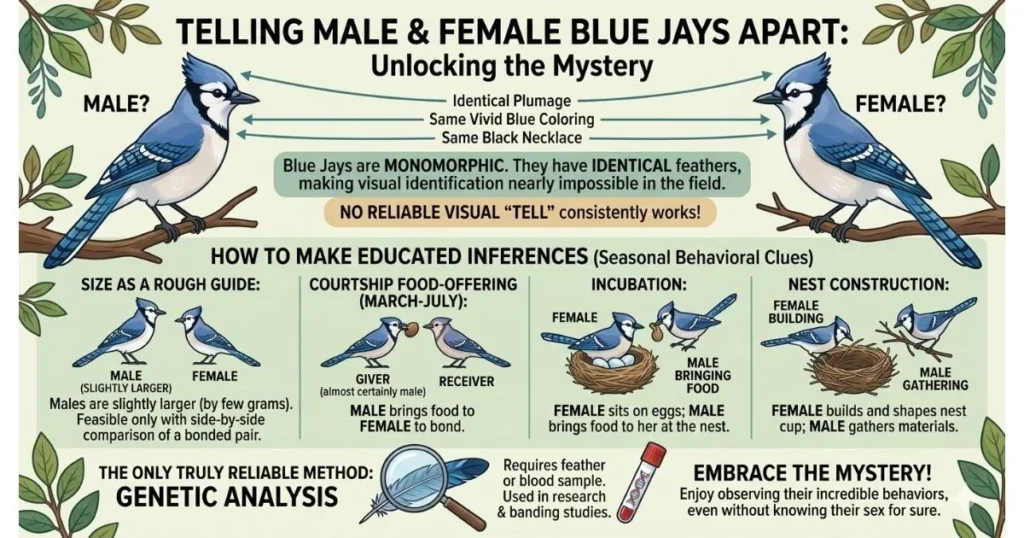
This is consistently one of the most asked questions in every Blue Jay discussion I encounter, on Reddit’s r/whatsthisbird, in backyard birding Facebook groups, at field workshops, and in my inbox.
The question is so persistent because the honest answer surprises most people.
With the naked eye, in the field, you mostly cannot distinguish male from female Blue Jays.
The Blue Jay is what ornithologists call a monomorphic species with respect to plumage, meaning both sexes have identical-looking feathers.
Both males and females carry the same vivid blue coloring, the same black necklace, the same white underparts, and the same pointed crest. There is no reliable visual “tell” that works consistently in the field.
However, with careful behavioral observation during the right season, you can make educated inferences:
Size as a very rough guide:
Males are typically a very slight average larger than females, typically a difference of just a few grams, but this difference is impossible to assess reliably from visual observation alone.
Only side-by-side comparisons of a known bonded pair, in good lighting conditions, might suggest a size difference. For most practical purposes, size cannot be used to sex Blue Jays.
Behavioral cues during breeding season (March–July):
This is where meaningful sex determination becomes possible without laboratory methods.
During courtship, the male typically performs food-offering behavior, bringing seeds, nuts, or insects to the female and presenting them as part of mate-bonding behavior.
If you observe one Blue Jay repeatedly delivering food items to another Blue Jay that receives them passively, the food-giver is almost certainly the male.
During incubation, the female sits on the eggs while the male brings food to her at or near the nest. A Blue Jay that leaves the nest area and returns with food is almost certainly the male; the bird remaining on or near the nest is the female.
During nest construction, the female does the majority of the actual weaving and shaping of the nest structure, while the male primarily gathers and delivers materials.
If you can observe a nest under construction, the bird actively building the cup is most likely female; the bird arriving with twigs and departing for more materials is most likely male.
The reliable method:
The only truly reliable way to determine sex in a Blue Jay is genetic analysis (DNA sexing), which requires a feather or blood sample and laboratory testing.
This is the method used in research and banding studies. For backyard observation, behavioral cues during the breeding season are your best tool.
Embrace the mystery when no behavioral context is available; it doesn’t affect your ability to enjoy, feed, and observe these birds.
Bald Blue Jay – What’s Wrong?
If you’ve ever seen a Blue Jay land at your feeder with no feathers on its head, or feathers so scruffy and sparse that the dark skin underneath is clearly visible, you know the moment of alarm this triggers.
It looks wrong. It looks sick. It looks like something terrible is happening to this bird.
The good news, in most cases, is that the bird is almost certainly fine.
Let me explain exactly what you’re seeing and what it means.
The most common cause: simultaneous molting
All Blue Jays molt their feathers annually, replacing old, worn feathers with fresh new growth.
For most of the body, this process is gradual and sequential, with old feathers dropping out and new ones growing in a few at a time, so the bird never looks obviously disheveled.
But the head feathers of some Blue Jays molt simultaneously; all the old head feathers drop out at nearly the same time, leaving the bird temporarily bald-headed.
The exposed skin is typically dark gray to black. The new feathers begin growing immediately, and the bird returns to normal appearance within two to three weeks.
This simultaneous head molt typically occurs in late summer, which is why “bald Blue Jay season” is most common from late July through September.
After eighteen years of watching birds at my Asheville feeders, I see at least two or three bald Blue Jays every year during this period. It startled me the first time.
Now I recognize it immediately and appreciate the brief window it gives us to see the bird’s actual head shape without the crest.
- Simultaneous Feather Loss During Molting
Other causes of feather loss in Blue Jays:
Feather mites and lice (ectoparasites):
External parasites can cause feather damage, breakage, and loss, particularly around the head and neck, where the bird cannot easily preen its own feathers.
A Blue Jay with parasite-related feather loss typically shows uneven, patchy baldness rather than a clean bald head, and may be seen scratching or rubbing its head against branches more frequently than normal.
Very heavy parasite loads can cause lethargy and reduced foraging efficiency, but most birds manage their parasite burden adequately through preening and dust bathing.
Nutritional deficiency:
Blue Jays that lack adequate protein during the molting period, which coincides with late summer when insect availability may be declining, can experience poor feather regrowth, with feathers growing in thinner, dull, or abnormally structured.
If you’re concerned about a bald Jay returning to your feeder repeatedly, ensuring high-quality, protein-rich food is available, such as whole peanuts, sunflower seeds, and suet, can support healthy feather regrowth.
Feather follicle damage:
In rare cases, viral infections, mite damage, or physical injury can permanently damage the feather follicles in a specific area, resulting in a bird that cannot grow feathers in that region at all.
These birds are identifiable because they remain partially bald year-round and throughout subsequent molting cycles, while other Blue Jays in the same area look perfectly normal.
What should you do if you see a bald Blue Jay at your feeder?
Watch it for a week or two.
If the bird is active, foraging normally, responding to alarm calls, maintaining its social position in the flock, and showing no other signs of distress, you are almost certainly watching a normal late-summer molt. No intervention is needed.
If the bird appears lethargic, isolated, is failing to evade other birds’ challenges, or the baldness extends significantly beyond the head and persists through fall and winter, contact your local licensed wildlife rehabilitator for guidance.
Blue Jay vs Bluebird
Let’s settle this comprehensively, because this is the single most common bird confusion question I encounter in backyard birding communities, whether it’s Reddit, Facebook groups, local Audubon chapter meetings, or my own feeder-watch workshops in Asheville.
Blue Jay and Eastern Bluebird are completely different birds. Different family, different size, different behavior, different voice, different ecological niche, different habitat preferences, and different feeder preferences.
The only characteristics they genuinely share are that both are blue and both live in North America.
Here is the complete, side-by-side comparison:
| Feature | Blue Jay | Eastern Bluebird |
|---|---|---|
| Scientific name | Cyanocitta cristata | Sialia sialis |
| Family | Corvidae (Crow family) | Turdidae (Thrush family) |
| Size | 9–12 inches, Robin-sized | 6.5–8 inches, between Sparrow and Robin |
| Weight | 2.5–3.5 oz (70–100g) | 1–1.4 oz (27–40g) |
| Blue color | Vivid, bright, electric blue upperparts | Softer, medium blue on back and wings |
| Chest/belly | White to pale gray | Males: rich rusty orange; Females: paler orange-buff |
| Crest | Prominent, pointed, always visible | No crest — smooth, rounded head |
| Black markings | Bold black necklace/collar | No black necklace |
| Personality at feeders | Bold, dominant, displaces other birds | Gentle, shy, does not dominate feeders |
| Typical habitat | Forests, parks, mature suburban trees | Open fields, meadows, woodland edges with low perches |
| Sound | Harsh, loud “jay-jay” scream; hawk mimicry | Soft, melodious, warbling “chur-wi-lee” |
| Diet | Primarily nuts and seeds; insects in summer | Primarily insects and berries; prefers mealworms |
| Nesting | Open cup nest built in tree branch crotches | Strict cavity nester, requires tree cavities or nest boxes |
| Nesting preference | Does NOT use nest boxes | Strongly attracted to properly mounted bluebird boxes |
The fastest field identification in practice:
Look at the chest first. Eastern Bluebird males have that unmistakable warm rusty-orange breast, one of the most beautiful and distinctive colors in North American birds, completely unlike anything on a Blue Jay.
Blue Jays have white or pale gray underparts with a bold black collar.
Look for the crest second. Bluebirds have no crest at all; the head is smooth and rounded. If the bird has a pointed crest on its head, you are looking at a Blue Jay, period.
Look at the habitat third. Is the bird perched on a fence post in an open meadow or agricultural field? Almost certainly a Bluebird. Is it in a tree canopy in a suburban yard or woodland? Blue Jay territory.
Blue Jay vs Steller’s Jay
While the Blue Jay/Bluebird confusion is most common among beginners, the Blue Jay vs Steller’s Jay confusion trips up intermediate and even experienced birdwatchers, particularly anyone who travels between the eastern and western United States for birding, or anyone relocating from one coast to the other.
The confusion is understandable because these two birds are genuinely closely related. Both are Corvids, both have prominent crests, both are loud and bold, and both are strikingly blue.
But once you understand the key differences, they are straightforward to separate.
| Feature | Blue Jay | Steller’s Jay |
|---|---|---|
| Scientific name | Cyanocitta cristata | Cyanocitta stelleri |
| Range | Eastern and central North America | Western North America (Rocky Mountains to Pacific Coast) |
| Head and front color | Blue with white face, black necklace | Sooty black on head, neck, and chest, the entire front half |
| Body color | Vivid medium blue with white markings | Sooty black on the head, neck, and chest, the entire front half |
| Crest | Blue, moderate length | Black, longer, more dramatic, often described as “swept back.” |
| White markings | Prominent white spots on wings, white tail corners, white face | Prominent white spots on wings, white tail corners, and white face |
| Underparts | White to pale gray | Deep blue, matching the body |
| Personality | Bold, noisy, adaptable | Equally bold and noisy in its own range |
| Primary habitat | Deciduous and mixed forests | Coniferous forests, mountain slopes, Pacific Coast forests |
The simplest rule I give to birders transitioning between regions:
If the bird has a black head and black chest with a dark blue body, you are in the western United States looking at a Steller’s Jay.
If the bird has a blue head, a white face, and a black necklace across a white chest, you are looking at a Blue Jay.
Do their ranges overlap?
Very rarely and only marginally. The two species’ primary ranges barely intersect. Blue Jays dominate east of roughly the 100th meridian, while Steller’s Jays dominate west of the Rocky Mountains.
In the narrow contact zone along the eastern edge of the Rockies, in states like Colorado, Wyoming, and New Mexico, both species can potentially be observed, and confirmed hybrids between the two species have been documented.
If you believe you have found a Blue Jay × Steller’s Jay hybrid, a bird that shows intermediate characteristics, please document it carefully with photographs and submit the record to eBird.
These hybrids are scientifically valuable and genuinely rare.
Blue Jay Habitat – Where Do Blue Jays Live?
Understanding where Blue Jays live is essential for finding them, attracting them to your yard, and interpreting their behavior.
In eighteen years of field observation across much of the eastern United States, I’ve found Blue Jays in a broader range of habitat types than almost any other species in my study area, but they do show clear and consistent preferences.
Primary Habitat: Oak Forests and Mixed Deciduous Woodlands
The Blue Jay’s single most important habitat association is with oak trees (genus Quercus). This relationship runs so deep that it can fairly be described as one of the great ecological partnerships in North American wildlife.
The Blue Jay’s entire biology, its stout bill, its expandable throat pouch, and its extraordinary spatial memory can be understood as adaptations to a diet and lifestyle built around the oak.
Blue Jays favor:
- Mixed deciduous forests dominated by oaks, beeches, and other mast-producing hardwoods, particularly White Oak, Scarlet Oak, Red Oak, and Chestnut Oak in the eastern US
- Forest edges, where trees transition to open areas, these edge habitats provide foraging opportunities in both woodland and open-ground settings
- Mature suburban neighborhoods with large, established trees, particularly oak-dominated yards and street tree plantings
- City parks with significant canopy cover and diverse tree species
- Riparian corridors, the tree-lined margins of streams and rivers that provide both food resources and movement corridors through otherwise open landscapes
Geographic Range
Blue Jays occupy a large portion of North America with a year-round presence across most of their range:
- Northern limit: Southern Canada, Ontario, Quebec, Manitoba, Saskatchewan, and into southeastern British Columbia
- Southern limit: The entire Gulf Coast, including Florida
- Eastern limit: The Atlantic seaboard from Maine to Florida
- Western limit: The eastern edge of the Rocky Mountains, eastern Colorado, Wyoming, the Dakotas, Nebraska, Kansas, Oklahoma, and Texas
In the western United States proper, California, Oregon, Washington, Nevada, and Arizona, the Blue Jay is absent (replaced by Steller’s Jay and Western Scrub-Jay).
If you think you’re seeing a Blue Jay in Los Angeles or Seattle, look again carefully; what you’re seeing is almost certainly a different species.
Urban and Suburban Adaptability
Of all the insights my eighteen years of field work have generated, one of the most consistent is this: Blue Jays are among the most successful urban adapters among North American forest birds.
Their populations in mature suburban neighborhoods frequently exceed their densities in comparable tracts of rural forest.
The reason is resource abundance. A mature suburban neighborhood with well-established trees, diverse plantings, bird feeders, and access to water provides Blue Jays with everything they need: food, shelter, nesting sites, and water in a compact, reliable package.
Their intelligence (which we discuss at length in the next section) makes them particularly efficient at discovering and exploiting novel resources like bird feeders.
Blue Jay Behavior & Intelligence
This section is where I need you to stop skimming and read with full attention, because what I’m about to tell you about Blue Jay intelligence is one of the genuinely extraordinary stories in North American ornithology, and the vast majority of backyard birdwatchers have no idea what they’re actually watching when a Blue Jay lands at their feeder.
Blue Jays Are Corvids – The Smartest Birds on Earth
The Corvidae family contains the most cognitively sophisticated birds ever studied.
- Corvidae family
Crows and ravens have been documented using tools to solve multi-step physical problems, recognizing and remembering individual human faces across years, planning for future events, a cognitive ability that was previously thought unique to great apes, and engaging in what appear to be complex social rituals around their dead.
Blue Jays share this cognitive heritage, and field research has documented their intelligence in ways that continue to astonish behavioral scientists.
Tool Use:
In controlled captivity studies, Blue Jays have been observed spontaneously using strips of newspaper as tools, raking them through their cage bars to pull food items within reach.
This is one of the very few documented instances of spontaneous, unprompted tool use in a bird species outside the core crow-raven lineage.
The birds were given no training and received no reward clues; they simply figured it out.
Extraordinary Spatial Memory:
Every fall, a single Blue Jay may cache, individually bury in separate locations, 3,000 to 5,000 acorns and other nuts across its home range.
The bird must then locate and retrieve the vast majority of these individual caches across the following winter and spring, often under snow cover and months after the initial caching.
Research has shown that Blue Jays successfully retrieve a remarkable proportion of their caches, demonstrating spatial memory capacity that rivals and in some respects exceeds the working memory of most mammal species.
Each cache location is stored as an independently retrievable memory. This is not “instinct” in any meaningful sense of the word; it is genuine, high-fidelity episodic memory.
Hawk Mimicry:
Blue Jays produce remarkably accurate vocal imitations of Red-tailed Hawks, Cooper’s Hawks, Broad-winged Hawks, and other raptor species.
Their mimicry is accurate enough to fool experienced birders. I’ve personally been fooled more than once while working in dense vegetation.
The function of this mimicry has been debated in the ornithological literature for decades. Leading hypotheses include: triggering false alarm responses in competing birds to clear a feeder or food source, testing an area for the presence of actual hawks before committing to descend, and communication between family members using a shared signal.
In my own eighteen years of observation, I have watched Blue Jays produce hawk calls immediately before arriving at a feeder populated by other birds, and watched those other birds flush, and then watched the Blue Jays land and feed on the now-vacated feeder.
Whether this represents intentional tactical deception or a coincidental sequence of events, I’ll leave to you to judge, but I’ve observed it consistently enough to find it difficult to dismiss as a coincidence.
Social Learning and Cultural Transmission:
Young Blue Jays learn foraging techniques, food preferences, cache site strategies, and threat recognition from observation of older family members.
There is strong evidence suggesting that acorn-caching behavior and site selection strategies are passed down culturally across generations within local populations, meaning that the Blue Jay family groups at your feeder may be operating with accumulated behavioral knowledge that is genuinely older than any individual bird.
Complex Vocal Communication:
The Blue Jay’s vocal repertoire includes at least a dozen functionally distinct calls:
- Loud alarm calls that trigger community-wide predator responses
- Soft contact calls are used for mate and family communication
- Bell-like foraging calls
- Territorial calls
- Hawk mimicry (discussed above)
- A quiet, surprisingly melodious “whisper song” used in courtship contexts
Mate Loyalty and Long-Term Pair Bonds
Blue Jays are monogamous and form lasting pair bonds that often persist across multiple breeding seasons and potentially for life.
A mated pair maintains their social connection year-round, foraging in proximity, roosting near each other, and performing regular contact-calling to maintain communication.
Family flocking behavior:
The young of the current breeding season often remain with the family group through fall and winter before dispersing, a behavior called family flocking.
The Blue Jay “gang” arriving at your feeder together in October may very well be a mated pair with their most recent offspring, operating as a coordinated family unit.
Sentinel Behavior – The Blue Jay as Community Guardian
One behavior that significantly underappreciates the Blue Jay’s value to the broader bird community is its role as a sentinel species.
Blue Jays are extraordinarily vigilant for aerial predators and will alarm-call loudly and persistently the moment a hawk, owl, or other threat enters the area.
This alarm call is recognized and responded to by virtually every other bird species in the yard. Chickadees take cover, finches flush, sparrows freeze, and even squirrels respond.
I have birdwatching friends who complain that Blue Jays “scare away all the good birds.” These same friends have never, to my knowledge, lost a bird to a hawk attack they saw coming, because the Blue Jay was already screaming about it, long before a human eye would have detected the threat.
What Do Blue Jays Eat in the Wild – and at Your Feeder?
Blue Jay diet is one of the most important and most surprising topics for anyone trying to understand or attract this species.
The full picture of what Blue Jays eat, and why, reveals their central importance to the ecosystems they inhabit.
The Acorn Partnership – One of North American Ecology’s Great Stories
The relationship between the Blue Jay and the oak tree is one of the most important ecological partnerships in temperate North America, and it is profoundly underappreciated.
Every fall, a single Blue Jay can cache 3,000 to 5,000 acorns in a single season. The bird accomplishes this by using its expandable throat pouch, a specialized structure most backyard observers don’t realize exists, to carry up to 5 acorns at a time, which it then buries individually at separate locations across its territory, typically pressing them 1–2 inches into the soil.
The bird retrieves the vast majority of these caches over the following winter and spring. But critically, not all of them. The unclaimed acorns germinate. Oak trees grow.
Research from the Cornell Lab of Ornithology and multiple university programs has demonstrated that Blue Jays are responsible for a significant portion of post-glacial oak forest expansion across eastern North America.
The birds carry acorns up to a mile or more from the parent tree, far beyond what wind, gravity, or squirrel caching behavior can achieve. They select sound, viable acorns with high germination probability.
They bury them at depths ideal for germination. And they bury them in open areas, forest gaps, and disturbed soils where young trees have the light access they need to establish.
Put simply: if there are oak trees in your state, Blue Jays were instrumental in putting them there. The bird you’re watching at your feeder is a primary architect of the forest ecosystem it inhabits.
Complete Blue Jay Diet
Plant foods (approximately 60–70% of annual diet):
- Acorns, the primary food item, are especially available from fall through spring
- Beechnuts and hickory nuts
- Sunflower seeds (both black-oil and striped)
- Corn (dried whole kernel, cracked corn)
- Wild berries: pokeweed, wild cherry, dogwood berries, elderberries, sumac
- Cultivated fruit and grain when available
Animal foods (approximately 30–40% of annual diet):
- Grasshoppers, beetles, crickets, and other large insects are particularly important in summer
- Caterpillars and larval insects
- Spiders
- Occasionally, small vertebrates: tree frogs, lizards (rare and opportunistic)
- Eggs and nestlings of other birds (much less common than widely believed, see below)
The Egg-Robbing Controversy – Setting the Record Straight
The Blue Jay’s reputation as a nest predator, a serial killer of other birds’ eggs and nestlings, is one of the most persistent and most overstated characterizations in backyard birding culture.
Systematic studies of Blue Jay stomach contents conducted across multiple decades and geographic regions have found that bird eggs and nestlings account for less than 1% of the total annual diet.
When the behavior occurs, Blue Jays will opportunistically take eggs or nestlings when they encounter unguarded nests during routine foraging, but this is an incidental occurrence, not a behavioral specialty.
The more accurate picture, supported by decades of diet research: the Blue Jay is a seed and nut specialist that supplements its diet heavily with insects in summer and takes bird eggs or nestlings opportunistically at an ecologically negligible frequency.
Its reputation as a nest predator is largely based on anecdotal feeder-watching observations taken dramatically out of their dietary context.
What to Feed Blue Jays at Your Feeder
If you want to attract Blue Jays to a feeder, and once you understand them, most people definitely do, these are the most effective offerings:
1. Whole peanuts in the shell: The single most effective Blue Jay attractant I know of. They detect peanuts rapidly and visit persistently for them. Results are typically visible within 24–48 hours in any area with resident Blue Jays.
2. Black-oil sunflower seeds: A staple that every Blue Jay in the eastern US will eat readily. Works well in platform feeders and hopper feeders.
3. Dried whole-kernel corn or cracked corn: Excellent on a platform feeder, especially in fall and winter. Blue Jays go through corn at an impressive rate during the period when they’re actively caching.
4. Acorns: If you have oak trees and can collect fallen acorns in autumn, scattering them on a platform feeder is a powerful Blue Jay draw. The birds will cache as many as they can carry.
5. Suet: Particularly effective in cold weather when high-calorie foods are most valuable. Blue Jays will visit large suet cages readily.
Blue Jay Nesting Habits – Where Do Blue Jays Build Their Nests?
Blue Jay nesting behavior presents an interesting paradox for the observer: these spectacularly bold, loud, dominant birds become remarkably secretive when it comes to their nest location.
Understanding this behavior and the biology behind it makes spring and summer Blue Jay watching significantly more rewarding.
Nest Site Selection
Blue Jays nest in trees and large shrubs, placing their nests in the crotch formed where a branch meets the trunk or a larger branch, or within a dense tangle of branches that provides both structural support and visual concealment from below.
Nest heights range from as low as 3 feet to as high as 25 feet, with most nests in the 10–20 foot range.
Nest trees are typically deciduous broadleafs with significant canopy cover, oaks, maples, beeches, and similar species. Blue Jays occasionally nest in coniferous trees (particularly in the northern part of their range), but deciduous trees are strongly preferred.
The secrecy behavior:
Despite their feeder-side boldness, Blue Jays near their nest become conspicuously quiet. They will stop their usual loud calling when approaching the nest site, taking deliberately indirect flight paths that make nest location extremely difficult to determine from observation.
A Blue Jay may land 30 feet from the nest in a different tree, then hop through the canopy silently to reach the nest, a behavior that consistently fools potential nest predators and occasionally fools experienced birdwatchers, too.
Nest Construction
Blue Jay nests are well-engineered structures built to last through the full breeding cycle and beyond:
Outer structure: Twigs from deciduous trees, plant roots, and bark strips, sometimes including human-provided materials such as string, paper strips, or cloth fiber when available.
Middle layer: Wet plant matter, mud, or decomposing leaves. Blue Jays often incorporate a mud layer into their nest construction that hardens as it dries, creating a rigid, weather-resistant cup that holds its shape significantly better than most songbird nests.
Inner lining: Fine rootlets, grass stems, and occasionally feathers.
Completed nests are roughly 7–8 inches in outer diameter and 3–4 inches deep, substantially more robust than many comparably-sized songbird nests.
Labor division in nest building: The female does the primary weaving and shaping of the nest structure. The male brings building materials, twigs, roots, and mud to the nest site, where the female incorporates them.
This is the standard corvid division of labor and is consistent across Blue Jay breeding pairs I’ve observed.
Egg Identification and Incubation
Blue Jay eggs are distinctive and identifiable:
- Color: Pale blue-green to olive-buff, with irregular brown, olive, or gray spots distributed across the surface
- Clutch size: Typically 3–7 eggs per clutch, with 4–5 being most common
- Incubation period: 16–18 days, performed primarily by the female
- Egg dimensions: Approximately 1.1 × 0.8 inches (28 × 20 mm)
Nesting Season
Blue Jays breed once per year across most of the range, occasionally producing a second brood in southern populations:
- Nest construction: March through May
- Egg laying: April through June (peak in May across most of the eastern US)
- Hatching: 16–18 days after the last egg is laid
- Fledging: Young birds leave the nest approximately 17–21 days after hatching
Both parents feed the chicks, with the male initially feeding the female at the nest and both parents delivering food to the nestlings as they grow.
Baby Blue Jay Facts
Baby Blue Jays generate more urgent questions than almost any other topic in backyard bird care, because finding a young Blue Jay on the ground is a common, emotionally charged experience that most people feel unprepared for.
Development Stages from Egg to Fledgling
Nestling stage (approximately days 1–18):
Blue Jay chicks hatch altricial, completely helpless, naked, eyes sealed shut, and totally dependent on parental care for warmth, protection, and food.
In their first week, they are fed through parental regurgitation of partially digested food. Their eyes begin opening at approximately 4–5 days old.
By days 8–10, pin feathers emerge, the tightly rolled sheaths of developing feathers that give young birds a spiky, almost dinosaur-like appearance.
By days 12–14, the sheaths begin opening, and real feathers emerge, and the chick starts to look recognizably like a Blue Jay, though with shorter wings, a shorter tail, and softer, slightly less saturated plumage.
By day 16–18, most chicks are fully feathered and nearly full-sized, bracing themselves against the nest rim and exercising their wings.
Fledgling stage (approximately days 17–21 and onward):
Young Blue Jays leave the nest before they can fly competently. This is completely normal; it is how this species and many songbirds work, and it is called fledging.
Fledgling Blue Jays spend several days on the ground and in low branches, hopping around, exercising their wings, and still being fed by both parents while their flight feathers complete development.
The fledglings are fully feathered, have bright eyes, and will hop and flutter energetically if disturbed. They are not injured. They are exactly where the biology of their species intends them to be.
What to Do If You Find a Baby Blue Jay on the Ground
This question is one of the most common messages I receive, and the guidance is consistent:
If the bird is a nestling (little to no feathers, eyes closed or barely open): This bird fell or was blown from its nest. Try to locate the nest in the nearest tree; it is usually within 20–30 feet.
If you can safely reach the nest, gently replace the nestling. The parents will not reject it because you touched it. This is a myth with no biological basis.
If the bird is a fledgling (fully feathered, bright eyes, hops and flutters): Leave it alone. Do not pick it up. Do not move it indoors. Its parents are almost certainly watching from a nearby tree and will continue to feed and supervise it on the ground.
Removing a healthy fledgling from its parents causes far more harm than leaving it where it is. The only appropriate actions are to keep cats and dogs away from the area and to allow the bird’s natural development to continue.
When intervention is appropriate: A bird that is bleeding, has a visibly broken wing, shows extreme lethargy, or is clearly orphaned with confirmed dead or absent parents should be taken to a licensed wildlife rehabilitator.
Do not attempt to raise a Blue Jay yourself; they require a specialized diet and care, and improper hand-rearing causes developmental problems that can permanently impair the bird’s ability to survive in the wild.
Blue Jay Migration in the United States
Blue Jay migration is one of the most genuinely puzzling phenomena I’ve encountered in North American ornithology, and I’ve spent considerable time trying to understand it.
The puzzlement comes from a fundamental characteristic of the species: the Blue Jay is a partial migrant, meaning that within any given population, some individuals migrate while others remain year-round residents, and the pattern is not entirely predictable at the individual level.
What We Know
Migration is real and observable:
Blue Jay migration is most visible at established watch sites along eastern ridgelines and Great Lakes shorelines, locations where landscape features concentrate migrating birds into observable streams.
Sites including Hawk Mountain Sanctuary in Pennsylvania, Cape May Bird Observatory in New Jersey, and various points along the Lake Erie shoreline consistently record significant Blue Jay migration movements in fall, typically peaking in October.
Who migrates?
Research suggests that first-year birds (birds hatched the previous spring) are significantly more likely to migrate than adults.
This pattern, juveniles migrating more than adults, is common across many partial-migrant species and may reflect the greater survival advantage of moving south when you lack the cached food stores and territorial knowledge that established adult birds have built up.
What triggers migration?
Blue Jay migration appears responsive to a combination of food resource availability and weather cues.
Years following widespread mast crop failures, when acorn production across the northeast collapses, correlate with increased Blue Jay migration rates.
When the food supply is adequate, more birds stay put. When it’s poor, more birds move.
Irruption years:
In some years, very large numbers of Blue Jays migrate simultaneously, producing what birders call “irruptions.” During irruption years, hawk-watch observers have recorded thousands of Blue Jays passing in a single day at concentration points.
These events are typically correlated with documented regional acorn crop failures.
Migration distances:
Migrating Blue Jays typically move relatively short distances, 100 to 500 miles, rather than making the transcontinental flights characteristic of neotropical migrants.
Most movement is from northern breeding areas (Canada, northern New England, Great Lakes) to wintering areas in the central and southern US.
Implications for Backyard Bird Watchers
The practical takeaway: the Blue Jays at your feeder in winter may not be the same individual birds you see in summer.
Your resident Blue Jays may have moved south, replaced at your feeder by birds from farther north.
Alternatively, some of your summer residents may remain while migrants from the north augment your local numbers. Both patterns occur.
To track Blue Jay movements in real time, use eBird (ebird.org), search for Blue Jay sightings in your county over the past 30 days to get a current picture of local abundance and movement patterns.
Blue Jay Lifespan – How Long Do Blue Jays Live?
The average wild Blue Jay lives approximately 7 years. That said, this average is pulled down substantially by high first-year mortality; many birds that survive past their first year go on to live considerably longer.
The record: The oldest reliably documented wild Blue Jay was 26 years and 11 months old, captured, banded, and released during long-term banding studies.
This represents exceptional longevity for a bird of this body size and reflects the upper ceiling of what is biologically possible for the species.
In captivity, in zoos, research facilities, or wildlife rehabilitation settings, Blue Jays have lived to similar ages with appropriate care, suggesting that the average wild lifespan of 7 years reflects the cumulative mortality risks of life in the wild rather than an inherent biological limit.
Survival Rates Through Life Stages
Year one is the most dangerous:
As with virtually all songbird species, the first year of a Blue Jay’s life carries the highest mortality risk. Fledglings must rapidly develop the foraging skills, predator awareness, and social competence needed to survive without direct parental support.
Estimates of first-year Blue Jay survival range from roughly 50–60%, meaning nearly half of all birds hatched in a given year do not reach their first birthday.
Adult survival is much higher:
An adult Blue Jay that has survived its first year has accumulated significant advantages: knowledge of productive food sources, established cache sites, proven predator-avoidance skills, and often a secured territory and mate.
Annual adult survival rates are estimated at approximately 70–75% in stable populations.
Primary mortality factors:
- Predation: Cooper’s Hawks, Sharp-shinned Hawks, and Great Horned Owls are the primary avian predators; domestic cats are significant for fledglings
- Window strikes: Collisions with reflective windows cause substantial Blue Jay mortality, given the bird’s size and speed
- Disease: West Nile virus, which entered North America in 1999, has had documented impacts on corvid populations, including Blue Jays
- Severe weather: Extended cold snaps and ice storms in the northern range can cause mortality when food sources are inaccessible
- Human-associated hazards: Pesticide exposure, vehicle strikes, fishing line entanglement
Blue Jay Predators
What Are the Predators of Blue Jays?
Blue Jays are bold, vigilant, and well-equipped to detect and respond to predators, but they are not without vulnerabilities. Here is the complete picture of predation risk across different life stages.
Nest and Egg Predators:
- American Crows: Blue Jays and crows are family (both Corvids), but that relationship does not prevent crows from raiding Blue Jay nests for eggs and nestlings when the opportunity presents itself.
- Common Ravens: Similar to crows; nest predation documented in the northern portion of the range
- Raccoons: Highly capable climbers and among the most significant nest predators across North America
- Virginia Opossums: Opportunistic nest raiders that will take eggs and small nestlings when encountered
- Rat Snakes and Black Racers: Perhaps the most underappreciated nest predator for tree-nesting species; rat snakes are exceptional climbers capable of reaching nests at significant heights
- Eastern Gray Squirrels: Occasionally predatory on eggs
Predators of Fledglings and Adults:
- Cooper’s Hawk (Accipiter cooperii) is the single most significant predator of adult Blue Jays. The Cooper’s Hawk is anatomically and behaviorally specialized to hunt medium-sized forest birds; its short wings and long tail allow high-speed maneuvering through dense vegetation, and Blue Jays are a documented primary prey item. This predator-prey relationship is so important that it likely drives much of the Blue Jay’s sentinel behavior and hawk mimicry.
- Sharp-shinned Hawk (Accipiter striatus) Smaller than the Cooper’s, but a capable predator of juvenile Blue Jays and occasionally smaller adults
- Red-tailed Hawk (Buteo jamaicensis) Less common predator given the size differential, but documented, particularly during incautious moments
- Great Horned Owl (Bubo virginianus) Major nocturnal predator targeting Blue Jays at roosting sites; the powerful Great Horned Owl is capable of taking full-sized Blue Jays with ease
- Eastern Screech-Owl: Capable of taking fledglings and small adults
- Domestic cats (Felis catus) are one of the most significant human-associated mortality sources for ground-level fledglings. Free-roaming cats are estimated to kill billions of North American birds annually, and Blue Jay fledglings’ characteristic habit of spending several days on the ground makes them particularly vulnerable.
Predator Defense Behavior:
Blue Jays respond to predator detection with mobbing behavior, gathering multiple individuals to collectively harass and drive away the threat through persistent alarm calling, dive-bombing, and physical harassment.
This behavior is highly effective against most predators and is one of the most socially valuable behaviors Blue Jays perform for the broader bird community.
A Blue Jay mobbing a Great Horned Owl at a roost site will attract chickadees, nuthatches, woodpeckers, and other species to join the mob, creating enough disturbance to drive the owl out of the territory.
Why Do Blue Jays Scream So Loudly?
This is among the most exasperated questions in my inbox: “Why is my Blue Jay screaming at everything?!”
And it deserves a thorough answer, because the Blue Jay’s voice is not random noise. It is a sophisticated communication system, and understanding it fundamentally changes how you experience these birds.
The Blue Jay’s Complete Vocal Repertoire
The “jay-jay” alarm call:
This is the call that defines the Blue Jay in most people’s minds, a harsh, grating, two-syllable scream that carries hundreds of yards through dense forest. It is loud by biological necessity.
In a forested environment where sound attenuates rapidly with distance and competing background noise is constant, an effective alarm call must be capable of reaching every bird in the area. The Blue Jay’s alarm call is acoustically engineered to do exactly this.
When you hear the alarm call, something has triggered genuine concern in the Blue Jay. Possibilities include: a hawk overhead, a cat on the ground below, a human approaching too closely, an unfamiliar large animal, or sometimes a competing Blue Jay invading territory.
Pay attention to where the calling bird is looking; it will almost always be oriented toward the source of alarm.
The “jeer” contact call:
A softer, nasal sound used between mated pairs and family members to maintain contact during foraging.
This call says: “I’m here, where are you?” It is heard constantly in the background of any area with resident Blue Jays, and most people who haven’t specifically listened for it have never consciously registered it.
Once you learn this call, you will hear it everywhere.
The “tull-tull” foraging call:
A quiet, bell-like sound produced during relaxed foraging. If you hear what sounds like a small, distant bell coming from a tree canopy, there’s a reasonable chance a Blue Jay is foraging there. This call signals social ease and non-threat.
The whisper song:
Rarely heard and rarely recognized, the Blue Jay’s whisper song is a sustained, quiet combination of whistles, clicks, gurgles, and soft melodic phrases.
Males produce it during courtship, sitting near their mate and singing quietly for extended periods. It is surprisingly beautiful coming from a bird with such a public reputation for brashness.
Hawk mimicry:
As discussed throughout this guide, Blue Jays mimic the calls of Red-tailed Hawks, Cooper’s Hawks, Broad-winged Hawks, and other raptors with acoustic accuracy sufficient to fool both birds and experienced human observers.
The functional significance of this mimicry continues to be studied, but the behavior is well-documented, consistent, and purposeful.
Are Blue Jays Aggressive to Other Birds?
This is a nuanced question that deserves a nuanced answer, because the reality is substantially more complex than the “feeder bully” reputation suggests.
The Feeder Dominance Reality
Blue Jays are larger than most birds they share feeders with, and size hierarchy is a real and consistent feature of bird community dynamics at feeders.
Chickadees defer to nuthatches; nuthatches defer to House Finches; House Finches defer to Mourning Doves; Mourning Doves defer to Blue Jays.
This is not malice; it is the same dominance hierarchy visible in every mixed-species feeding aggregation.
When a Blue Jay arrives at a platform feeder occupied by smaller birds, those birds will typically move aside. This is the behavior most backyard observers describe as “aggression”, but it is functionally identical to a large dog entering a room full of small dogs.
The big animal gets space; the small animals give it.
The aggression level varies significantly with context:
At well-supplied feeders with abundant food, Blue Jays frequently feed with minimal conflict, grabbing seeds or peanuts rapidly and departing, allowing smaller birds to resume feeding within minutes.
At competitive feeders with limited food and high demand, Blue Jays may actively chase, dive-bomb, and repeatedly displace other birds.
This is the “bully feeder” behavior that gives Blue Jays their bad reputation.
Do Blue Jays permanently drive away other birds?
No. This is one of the most persistent and least accurate myths in backyard birding.
Smaller bird species learn the behavioral patterns of dominant birds at their feeders and develop strategies around them, timing feeder visits for periods between Blue Jay visits, using smaller tube feeders that the Blue Jays cannot access comfortably, and returning rapidly when the jays depart.
In any yard with regular Blue Jay visitors, the smaller birds will be present and active; you simply have to watch the full rhythm of feeder use across the day rather than focusing only on the moments when Blue Jays are present.
Strategies to Reduce Feeder Competition
Multiple feeder stations: Distributing feeders across different areas of the yard prevents any single bird from monopolizing all food sources. Blue Jays can only be at one feeder at a time.
Tube feeders for small-bird seeds: Nyjer/thistle feeders, small-port tube feeders for finch mix, and other narrow-perch feeders are inaccessible or uncomfortable for Blue Jays. These feeders serve as effectively “Blue Jay-free zones” for finches, chickadees, and similar small birds.
A dedicated Blue Jay station: A platform feeder with whole peanuts and corn, positioned slightly away from your main mixed feeding area, gives Blue Jays their own food source that they’ll preferentially visit, reducing their motivation to compete at the other feeders.
What Attracts Blue Jays to Your Backyard?
If you want to attract Blue Jays specifically, and I’ve found that once backyard birdwatchers truly understand these birds, the majority do want to attract them, here is the evidence-based approach that I use, recommend, and have consistently seen produce results.
The Six Most Effective Blue Jay Attractants
1. Whole Peanuts in the Shell
This is, without question, the single most effective Blue Jay attractant in my backyard birding toolkit. Blue Jays respond to peanuts more urgently and more persistently than almost any other food.
Set out whole unshelled peanuts on a platform feeder or in a wire peanut feeder, in areas with resident Blue Jays, you will typically see your first visitor within 24–48 hours.
Blue Jays are drawn to peanuts for the same reason they’re drawn to acorns: high fat content, high protein, and high caloric density make them ideal for caching and for sustaining energy through cold weather.
The birds will carry peanuts away to cache them as well as eat them on-site, so you’ll go through peanuts at an impressive rate, which tells you how valuable they are to the birds.
2. Sunflower Seeds
Both black-oil sunflower seeds (the small, thin-shelled variety that is the most widely available) and striped sunflower seeds (larger, with thicker shells) are readily taken by Blue Jays.
Black-oil sunflower seeds on a platform feeder or in a hopper feeder will attract Blue Jays, along with a wide variety of other desirable species, including cardinals, chickadees, and nuthatches.
3. Dried Whole-Kernel Corn or Cracked Corn
Corn is a high-calorie, widely available food that Blue Jays cache enthusiastically. A platform feeder with dried whole-kernel corn or cracked corn is a reliable Blue Jay draw, particularly in late summer and fall when the birds are in intensive caching mode.
Cracked corn also attracts Mourning Doves, sparrows, and other ground-feeding species, making it a high-value addition to any backyard feeding program.
4. Oak Trees
No feeder or food offering attracts Blue Jays as powerfully or as naturally as mature oak trees. If your yard contains established oaks, Blue Jays will find them. If you don’t have oaks, consider planting native oak species.
White Oak (Quercus alba), Scarlet Oak (Quercus coccinea), and Pin Oak (Quercus palustris) are all native to much of the eastern US, produce excellent acorn crops, and support an extraordinary diversity of wildlife beyond Blue Jays.
Oaks are slow-growing investments; you’re planting for future generations of birdwatchers as much as for yourself. But there is no better long-term bird habitat decision you can make for an eastern US yard.
5. Moving Water
Blue Jays are strongly attracted to the sound and sight of moving water.
A birdbath with a dripper, a water wiggler, a small recirculating fountain, or even a garden hose set to a slow drip creates the ripples and splashing sounds that signal water to birds from a significant distance.
Water attraction is particularly powerful in summer, when natural water sources may be reduced, and in winter, when liquid water is scarce, and a heated bird bath becomes an extraordinary resource.
A consistent, clean, moving water source is one of the most cost-effective bird attraction investments in any backyard.
6. Native Plantings
Blue Jays use dense native shrubs and trees for shelter, predator avoidance, and natural foraging. Planting species that produce berries, nuts, or insects provides food resources that bring Blue Jays to your yard independent of feeders:
- Serviceberry (Amelanchier spp.) Berries ripen in early summer, heavily used by Blue Jays and many other species
- Flowering Dogwood (Cornus florida) Fall berries are a Blue Jay staple
- Wild Cherry (Prunus serotina) Fruit and insect resources also serve as a host plant for many caterpillar species
- Elderberry (Sambucus canadensis) is a fast-growing native shrub with berries used by over 120 bird species
- Native oaks (as discussed above)
Best Bird Feeder for Blue Jays
Given their body dimensions (9–12 inches long, 13–17 inches wingspan), Blue Jays require specific feeder designs to feed comfortably and consistently:
Platform/tray feeders: The gold standard for Blue Jays, a wide, flat surface with space to land, turn, and select food. These are where I put whole peanuts, corn, and sunflower seeds, specifically targeted at Blue Jays. Choose a model with drainage holes to prevent water pooling and easy cleaning access.
Hopper feeders (large models): Blue Jays feed comfortably at generously-sized hopper feeders. These work well for sunflower seeds and offer better weather protection than open platforms.
Wire peanut feeders: Specifically designed for whole unshelled peanuts, these cage-style feeders are extremely effective Blue Jay feeders. The birds enjoy the interactive challenge of extracting peanuts through the wire openings.
What to avoid: Small tube feeders with short perches, feeders with narrow ports, and feeders with weight-sensitive perches designed to close under the weight of large birds; these will exclude Blue Jays entirely.
What Does a Blue Jay Symbolize When You See One?
The Blue Jay has accumulated rich symbolic and spiritual significance across centuries of human culture in North America.
This section covers both the Indigenous cultural traditions and the contemporary folk symbolism that many backyard birdwatchers in the United States connect with.
Blue Jay Symbolism in Native American Traditions
The Blue Jay (and its western counterpart, the Steller’s Jay) held significant cultural roles in several Indigenous North American traditions, though meanings varied considerably between nations and regions.
The trickster archetype: In several Pacific Northwest traditions, the Jay (particularly the Steller’s Jay) was cast in the role of the trickster, a character that uses intelligence, mimicry, and deception to achieve its ends.
The Blue Jay’s documented habit of mimicking hawk calls to manipulate other birds is a behavior that seems almost designed to reinforce this archetype.
The trickster is not a villain; in these traditions, the trickster is a teacher, revealing truths about the world through unconventional and sometimes disruptive means.
Community protector: The Blue Jay’s sentinel behavior, loudly alerting the entire bird community to approaching predators, gave it the role of guardian or protector in some traditions.
The bird that never stops watching, never stops warning, and refuses to go quietly in the face of danger.
Boldness and courage: The Blue Jay’s fearlessness when mobbing predators many times its size, eagles, owls, hawks, and even humans approaching too close to a nest, made it a symbol of courage disproportionate to physical size. The lesson: speak up, stand your ground, and defend what matters.
Contemporary American Blue Jay Symbolism
In contemporary American folk spirituality and informal symbolism, the Blue Jay appears in several consistent contexts:
Clarity and assertive communication:
The vivid blue of the Blue Jay (blue being associated with clear communication, truth, and expression in Western symbolic traditions), combined with its unmistakably vocal nature, has made it a symbol of communicating directly, saying what needs to be said, and not apologizing for having a voice.
If you’ve been holding back something you need to say, some people see an unexpected Blue Jay encounter as a prompt to speak up.
Family loyalty and protection:
The Blue Jay’s strong pair bond, its family flocking behavior, and its fierce protection of nest sites have made it a symbol of family loyalty and long-term commitment. Blue Jays don’t leave when things get hard; they double down on protection.
Connection to those who have passed:
This is perhaps the most personally moving context in which people report Blue Jay encounters.
Many individuals, and I’ve heard this from dozens of birdwatchers over the years, describe feeling a powerful sense of connection to deceased loved ones when Blue Jays appear unexpectedly or repeatedly during periods of grief or remembrance.
Whether understood through a spiritual or psychological lens, the meaning these encounters hold for people is genuine and deserves respectful acknowledgment.
What does a Blue Jay symbolize when you see one?
The most widely shared themes across cultural traditions and contemporary symbolism: boldness, the courage to be visible and vocal, family loyalty, community protection, and the willingness to tell the truth even when silence would be easier.
The Blue Jay is the bird that screams a warning regardless of the personal cost. There are worse things to have as a symbol.
Blue Jay Feather Colors Meaning
We introduced the science of Blue Jay feather color in the identification section, but the biology deserves its own focused discussion, because it is one of the most counterintuitive and genuinely beautiful facts in all of ornithology.
The blue color of a Blue Jay feather is not created by blue pigment. None exists in the feather. The feathers are, in terms of their actual pigment chemistry, essentially brown and gray.
The vivid blue that makes this bird so recognizable is produced entirely by structural coloration, a physical phenomenon where the nanostructure of the feather’s barbules scatters incoming light in such a way that only blue wavelengths are reflected back to the eye, while other wavelengths are absorbed.
This is the same physical principle that makes the sky appear blue (Rayleigh scattering of sunlight by atmospheric molecules), and it produces a color with a quality that cannot be replicated by any pigment, because it changes subtly with viewing angle and lighting conditions, creating an iridescent quality that shifts from deep electric blue to muted gray-blue to nearly gray depending on how the light hits it.
The practical demonstration:
Find a fallen Blue Jay feather (they’re common under feeding stations in areas with resident Blue Jays; check local regulations about possession before collecting). Hold it in direct sunlight and rotate it slowly.
The color shifts visibly. Now move it into open shade, and the blue desaturates significantly. Now crush a small section of the feather between your fingers and look at it in diffuse light.
The structural arrangement is destroyed, and the color disappears entirely, revealing the underlying brownish-gray pigment.
Why does this matter beyond pure curiosity?
The structural color is a direct indicator of feather condition and, by extension, of individual bird health and fitness. A well-maintained, structurally intact feather produces vivid, saturated blue.
A worn, damaged, or nutritionally compromised feather produces dull, washed-out color.
Female Blue Jays may use the vividness of a male’s blue as an honest signal of his health and foraging ability during mate selection, making the physics of light scattering relevant to the biology of reproduction.
Do Blue Jays Stay in the Same Area Year-Round?
As discussed in the migration section, Blue Jays show highly variable individual behavior with respect to residency, making this one of the most genuinely complex questions in Blue Jay natural history.
The answer is: it depends on the individual bird. Within any Blue Jay population:
- Some individuals are permanent year-round residents that defend consistent territories and rarely, if ever, move more than a few miles from their breeding location
- Some individuals are seasonal migrants who move 100–500 miles south in the fall and return in the spring
- Some individuals show variable annual behavior, staying one year and migrating the next, apparently in response to food resource conditions
This is the defining characteristic of a partial migrant species, unlike strict migrants, where the behavior is universal, and unlike strictly resident species, where migration never occurs, partial migrants show individual-level variation that does not resolve into a clean rule.
What this means at your feeder:
The Blue Jays visiting your yard in December may not be the same individuals present in June.
Your summer residents may have moved south, replaced by birds from Ontario or Quebec that are themselves “winterizing” in your area.
Alternatively, and this is equally possible, your summer Blue Jays may still be present, augmented by migrants from the north.
Without banding individual birds, separating resident individuals from migrants at a backyard feeder is extremely difficult. The practical advice: keep your feeders consistently stocked year-round.
You are providing value to both resident and migrant birds, and the consistency of your offering will build the trust of whatever Blue Jays are present, resident, migrant, or both.
Blue Jay Conservation Status – Are Blue Jays Endangered?
No. Blue Jays are not endangered. The species is listed as Least Concern by the IUCN Red List, and their populations across most of their range are stable to increasing.
Blue Jays have benefited, on net, from the expansion of suburban and agricultural landscapes across eastern North America; these human-altered environments have created large areas of edge habitat and food availability that suit the species well.
However, this overall stability does not mean the Blue Jay faces no threats. Responsible backyard birdwatchers can meaningfully support Blue Jay populations through several well-documented actions:
Prevent window strikes:
An estimated 600 million birds are killed by window collisions in the United States every year. Blue Jays, large, fast, and highly mobile, are particularly vulnerable to fatal window strikes.
The most effective mitigation approaches include applying window decals or tape in patterns spaced no more than 2 inches apart (the standard guideline for visible bird deterrents), angling large windows slightly downward, and placing feeders either very close to windows (under 3 feet, so birds can’t build up dangerous speed) or very far from windows (over 30 feet, outside the immediate flight zone).
Keep cats indoors:
Free-roaming domestic and feral cats kill an estimated 1.3–4 billion birds annually in the United States.
Blue Jay fledglings on the ground during their 3–5 day post-fledging period are among the most vulnerable bird life stages to cat predation.
Keeping cats indoors eliminates this risk entirely for your immediate area.
Reduce or eliminate pesticide use:
Blue Jays depend on insects for a substantial portion of their summer diet, and their growing nestlings depend on insect protein even more heavily.
Systemic insecticides like neonicotinoids have been documented to reduce insect populations at the landscape scale, directly reducing the food available to birds during the breeding season.
Choosing pesticide-free, organic approaches to lawn and garden management supports the entire food web that Blue Jays depend on.
Plant native species:
Native plants support vastly more insect diversity than non-native ornamentals, which translates directly into more bird food.
A single native oak tree supports hundreds of insect species; a comparable non-native ornamental may support fewer than ten.
Native plantings are the highest-leverage single habitat intervention available to homeowners.
Submit your observations to eBird:
Every Blue Jay sighting you report to eBird (ebird.org) contributes to the largest ornithological database in history, informing migration research, population trend monitoring, and conservation decisions across the continent.
It costs nothing and takes three minutes. Your backyard observations are genuinely scientifically valuable.
Frequently Asked Questions About Blue Jays
What does a blue jay symbolize when you see one?
A Blue Jay carries symbolism of boldness, direct communication, family loyalty, and community protection across multiple cultural traditions.
In Native American traditions, it appears as both a community guardian (sentinel that warns of danger) and a trickster figure (clever, adaptive, willing to use mimicry and deception).
In contemporary American folk symbolism, encountering a Blue Jay is most commonly associated with being called to speak up, stand your ground, and protect what matters.
Many people also associate unexpected Blue Jay appearances with messages or the presence of deceased loved ones, particularly during periods of grief.
Are blue jays aggressive to other birds?
Blue Jays are dominant at feeders due to their size and will displace smaller birds, but systematic aggression directed at other species is relatively uncommon.
Feeder dominance behavior typically involves brief displacement rather than sustained conflict.
Providing multiple feeders, tube feeders for smaller bird seeds, and a dedicated Blue Jay station (platform feeder with peanuts and corn) are the most effective strategies for creating a yard that satisfies Blue Jays without significantly impacting other bird species.
What do blue jays eat in the wild?
In the wild, the majority of the Blue Jay’s annual diet, approximately 60–70%, consists of plant foods, primarily acorns and other hard mast in fall and winter, supplemented by berries, corn, and other seeds.
Insects, caterpillars, and other animal protein make up 30–40% of the diet, primarily in summer. Eggs and nestlings of other birds account for less than 1% of the annual diet, despite the Blue Jay’s reputation as a nest predator.
How can you tell a male from a female blue jay?
Males and females are visually identical. Sex can be inferred from behavioral observation during the breeding season: males deliver food to the incubating female and bring nesting materials; females do the primary nest construction and incubation.
Reliable sex determination outside the breeding season requires genetic analysis (DNA sexing).
Do blue jays stay in the same area year-round?
Blue Jays are partial migrants; some individuals are year-round residents, others migrate south in fall and return in spring, and some show variable behavior between years.
Whether the Blue Jays at your winter feeder are your year-round residents or migrants from farther north depends on your specific location and the behavior of the individual birds, which is not determinable without banding data.
Why do blue jays scream so loudly?
The Blue Jay has a functional, multi-call vocal repertoire that serves specific communication purposes.
The loud “jay-jay” call is an alarm signal that alerts the entire bird community to predator presence; its volume is ecologically necessary to carry through the forest at a distance.
Other calls include soft contact calls for family communication, foraging calls, courtship songs, and remarkably accurate mimicry of hawk species. Each call serves a distinct, identifiable purpose.
Do blue jays scare away other backyard birds?
Blue Jays temporarily displace other birds when present at shared feeders, but other birds return to feeders within minutes of Blue Jay departure.
No evidence supports the claim that Blue Jays permanently drive other species away from yards or feeding areas.
Multiple feeders, tube feeders for small-bird seeds, and a dedicated Blue Jay food station are the most effective practical solutions for households where feeder competition is a concern.
What attracts blue jays to your backyard?
Whole peanuts in the shell are the most powerful single Blue Jay attractant. Sunflower seeds, dried corn, and acorns (when available) are also highly effective food offerings.
Mature oak trees attract Blue Jays more powerfully than any feeder. Moving water, birdbaths with drippers or fountains, attracts Blue Jays reliably.
Native plantings that produce berries, insects, and shelter complete a comprehensive Blue Jay habitat.
Where do blue jays build their nests?
Blue Jays build open cup nests in trees and large shrubs, typically placed in branch crotches 3–25 feet above ground.
Nest construction uses an outer layer of twigs and roots, a middle layer of mud (which hardens to create a durable cup), and an inner lining of fine rootlets.
Blue Jays are secretive about nest locations despite their loud public behavior, approaching nests silently and indirectly to avoid revealing nest position to predators.
How long do blue jays live in the wild?
The average wild Blue Jay lives approximately 7 years, with the record being over 26 years. Mortality is highest in the first year. Adult annual survival rates are approximately 70–75%.
Key mortality factors include predation by accipiter hawks and owls, window strikes, domestic cat predation of fledglings, and disease, including West Nile virus.
The Transformation – From Feeder Bully to Forest Architect
Here is the epiphany I want you to carry away from everything in this guide.
When most people look at a Blue Jay at their feeder, they see a bully. A loud, pushy, blue bird that takes up too much space, scares away the cardinals, and screams at everything.
When I look at a Blue Jay at my feeder, I see a forest architect. A bird that is literally rebuilding the eastern forests of North America, one buried acorn at a time. A bird with cognitive complexity that rivals many mammals.
A bird whose loud voice is providing a neighborhood-wide predator warning system that benefits every living thing within a quarter mile.
A bird whose 26-year lifespan means that an individual at your feeder today may outlive the dog sleeping at your feet.
The Blue Jay is one of the most ecologically important, intellectually remarkable, and culturally significant birds in North America.
It lives right outside most of our windows, available for observation any morning of the year, no travel, no expensive optics required, no rare species permit needed.
That is not a nuisance.
That is a gift.
Go put whole peanuts on your platform feeder today. Your Blue Jays will find them before you get back inside, and I promise you, if you watch what happens next with the understanding you’ve built in this guide, you will never see this bird the same way again.
— Daniel Carter
Ornithologist & Wildlife Bird Specialist
Founder, Birdslife.blog
Asheville, North Carolina | 18+ Years Field Research
About the Author
Daniel Carter is a wildlife ornithologist and birdwatching educator based in Asheville, North Carolina, with over 18 years of field experience studying North American bird species. He holds a Bachelor of Wildlife Biology from the University of North Carolina and a Certificate in Ornithology from the Cornell Lab of Ornithology. He is a member of the National Audubon Society and an active contributor to the eBird Community Science Project. Daniel founded Birdslife (birdslife.blog) to create a science-based, beginner-friendly resource for bird identification, backyard bird feeding ecology, and bird conservation education.
Explore more on Birdslife:
- How to Attract Backyard Birds Year-Round
- Best Platform Feeders for Large Backyard Birds
- Understanding Bird Alarm Calls and What They Mean
- Native Plants That Attract the Most North American Bird Species
- Cooper’s Hawk Complete Identification Guide
- Steller’s Jay Complete Guide – Western North America
- Eastern Bluebird Complete Guide – Habitat, Nesting & Attraction
Sources & References
- Cornell Lab of Ornithology. AllAboutBirds.org – Blue Jay species account (Cyanocitta cristata)
- Tarvin, K.A. & Woolfenden, G.E. (1999). Blue Jay (Cyanocitta cristata). The Birds of North America, No. 469. Cornell Lab of Ornithology.
- Rodewald, P.G. (ed.) (2015). The Birds of North America. Cornell Lab of Ornithology, Ithaca, NY
- National Audubon Society. (2023). Field Guide to North American Birds: Eastern Region
- eBird Status and Trends (2024). Blue Jay abundance and range maps. Cornell Lab of Ornithology
- Marzluff, J.M. & Angell, T. (2005). In the Company of Crows and Ravens. Yale University Press
- American Bird Conservancy. (2021). Cats Indoors: The Campaign for Safer Birds and Cats
- Loss, S.R., Will, T., & Marra, P.P. (2013). The impact of free-ranging domestic cats on wildlife in the United States. Nature Communications