

| Quick Answer: Blue Jays nest once per year, typically between April and July, depending on location. They build bulky cup-shaped nests 10–25 feet up in trees, lay 3–6 olive or buff-colored eggs, and incubate them for 17–18 days. Nestlings fledge at 17–21 days. If you find a baby Blue Jay on the ground, leave it nearby; the parents are almost certainly still feeding it. |
Every spring, without fail, I hear the same questions from backyard birders across the country: Where are the Blue Jays building? Why is the yard suddenly so quiet? And, the classic panic call, there’s a baby bird on my lawn, what do I do?
Blue Jay nesting season is one of the most fascinating windows into corvid family life you can observe without leaving your property.
These birds are devoted, secretive, and surprisingly tender parents, a sharp contrast to their loud, assertive feeder personalities.
Understanding their nesting habits makes you a better host, a more informed birder, and, when something goes wrong, a more effective helper.
This complete Blue Jay nesting guide covers everything: nest identification, egg characteristics, baby bird development stages, what to do if you find a grounded fledgling, and a state-by-state nesting timeline for the most-searched locations across the US.
Table of Contents
Blue Jay Nesting Season: When Do Blue Jays Nest?
Blue Jays are single-brooded; they raise one clutch of young per year under normal conditions, though a failed nest may prompt a second attempt.
The core nesting season runs from April through July across most of the United States, but the precise timeline shifts meaningfully by latitude and regional climate.
The behavioral lead-up to nesting begins weeks before any eggs are laid. Watch for these early signs in late February and March:
- Paired courtship flights, male and female flying together in short loops through the canopy.
- Mate-feeding behavior, the male bringing food to the female, is a bonding ritual that strengthens pair bonds
- Increased quiet and reduced feeder activity, nesting Blue Jays deliberately suppress their normally loud behavior to avoid drawing predators
- Bill-wiping on branches, a courtship display often seen before nest site selection.
That last point, the sudden feeder quiet, catches many backyard birders off guard.
The Blue Jays that were dominating your platform feeder in February may seem to vanish in April. They haven’t gone far. They’re just being careful.
Field Note: In 14 years of yard monitoring, I've found that the day my Blue Jays go quiet at the feeder is the most reliable indicator that nest-building has begun, more reliable than calendar date or temperature.
Blue Jay Nesting Timeline by State
The table below shows approximate nesting windows for the most-searched states.
These are observational ranges; actual timing varies by year, elevation, and microclimate.
| State | Nest Building Begins | Eggs Laid | Fledglings Leave Nest |
| Ohio | Late March – early April | April – May | Late May – June |
| Pennsylvania | Late March – April | April – May | Late May – June |
| Illinois | Early-mid April | April – May | June |
| New York | April – early May | May | June – early July |
| Texas | March – early April | March – April | May – early June |
| Florida | February – March | March – April | May |
| North Carolina | Late March – April | April – May | Late May – June |
Note: Florida and Gulf Coast populations may begin nesting as early as February in warm years.
Northern states like New York and Minnesota can see late nesting into early July in cold spring seasons.
Blue Jay Nest Identification: What Does a Blue Jay Nest Look Like?
Blue Jay nests are bulky, well-constructed cup structures that blend surprisingly well into their surroundings, which is exactly the point.
Despite their bold personalities, Blue Jays are deliberate and careful nest-builders.
Size and Structure
A typical Blue Jay nest measures roughly 7–8 inches in outer diameter with a 4-inch inner cup depth.
It’s a substantial structure for a medium-sized bird, significantly larger than a Robin’s nest but lacking the mud lining that makes Robin nests distinctive.
Construction uses a layered approach:
- Outer framework: Twigs, sticks, bark strips, and sometimes paper, string, or wire. Blue Jays readily incorporate artificial materials
- Middle layer: Grass, leaves, and plant fibers woven to tighten the cup
- Inner lining: Rootlets, fine grasses, and occasionally mud or animal hair for insulation and structural stability
Location and Height
Blue Jays are generalist nesters; they build in a wide variety of tree species but strongly prefer conifers or dense deciduous trees that offer good concealment. Typical nest placement:
- Height: 10–25 feet above ground; most commonly in the 15–20 foot range
- Tree preference: Oaks, pines, spruces, and maples in forested yards; ornamental conifers in suburban settings
- Position: Fork of a horizontal branch near the trunk, giving structural support from multiple angles
- Concealment: Typically placed to be invisible from below — you’ll often find them only when leaves fall in autumn
Identification Tip: A Blue Jay nest found after leaf drop looks like a messy twig platform with a neat inner cup. If the outer wall includes bark strips, paper scraps, or even bits of string, Blue Jay is the most likely builder; they’re one of the few species that routinely incorporate man-made materials.
Daniel Carter
Blue Jay Eggs: Color, Size, and Clutch Information
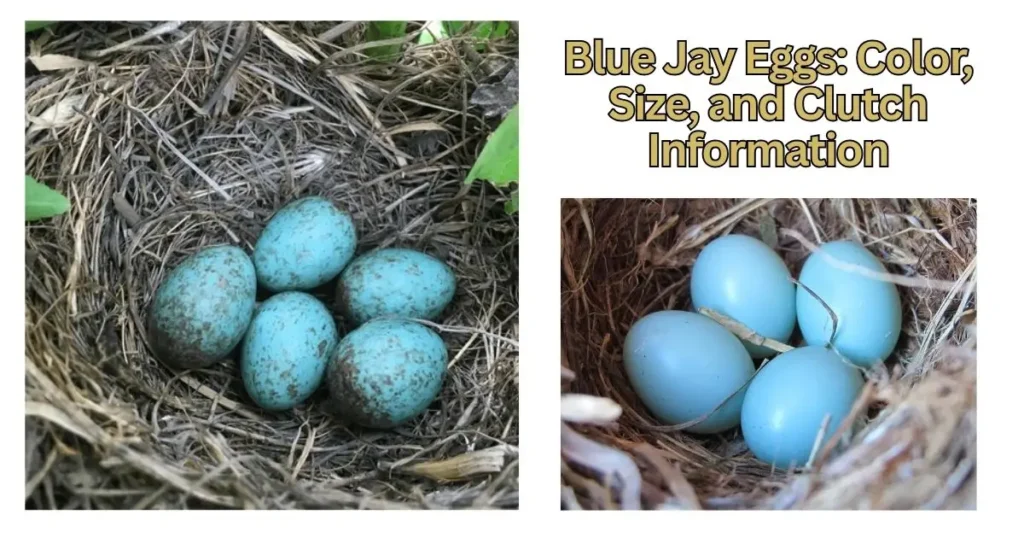
Blue Jay eggs are one of the nicer identification targets in backyard ornithology, distinctive enough to recognize once you know what to look for, though rarely seen since both parents guard the nest carefully.
What Do Blue Jay Eggs Look Like?
Blue Jay eggs are oval to slightly pyriform (pear-shaped) and measure approximately 28mm x 20mm, roughly the size of a large grape.
The base color ranges from olive-green to buff or pale blue, heavily spotted and streaked with brown, gray, and olive markings concentrated toward the larger end.
The speckled pattern serves as natural camouflage against nest materials, making the eggs difficult to spot even at close range. Fresh eggs have a faint sheen that dulls as incubation progresses.
Clutch Size
Blue Jays lay 3–6 eggs per clutch, with 4–5 being the most common count in healthy pairs with adequate food resources.
Clutch size tends to be smaller in younger or first-time breeding pairs and larger in experienced birds in high-quality territories.
How Often Do Blue Jays Lay Eggs?
Typically, once per year. If a nest fails early in the season, due to predation, storm damage, or abandonment, the pair will often re-nest within 2–3 weeks.
Second successful clutches in the same season are unusual but not impossible in years with early, warm springs in southern states.
Baby Blue Jay Development: From Hatching to Fledgling
The journey from egg to independent bird takes roughly 5–6 weeks total, a compressed timeline that reflects the vulnerability pressure of open-cup nesting.
Here’s how each stage unfolds.
Incubation Period (Days 1–18)
Incubation begins after the last egg is laid, lasting 17–18 days. Both parents incubate, though the female takes the longer overnight shifts.
The male feeds the female regularly during this period; the same mate-feeding behavior seen during courtship continues through incubation as a pair-bonding mechanism.
The nest is guarded aggressively during this phase. Blue Jays are among the more vocal defenders of active nests, loud alarm calls, dive-bombing of crows, cats, squirrels, and occasionally humans who approach too closely.
Nestling Stage (Days 1–21 After Hatching)
Hatchlings emerge naked, blind, and entirely helpless, altricial young typical of songbirds. Development is rapid:
- Days 1–5: Eyes closed; sparse gray natal down; completely dependent on parents for warmth and food
- Days 6–10: Eyes begin to open; pin feathers emerge on wings and back; distinctly blue coloring starts developing
- Days 11–15: Blue feathers fully visible; body covered; crest visible but still compressed
- Days 16–21: Near-adult size; flight feathers nearly complete; beginning to grip and move around nest rim
Both parents share feeding duties, bringing insects, seeds, berries, and occasionally small invertebrates.
The diet shifts toward higher-protein insect content during the early nestling stage to support rapid tissue and feather growth.
Parent Behavior: During the nestling stage, adult Blue Jays become dramatically quieter than usual, almost unrecognizable to backyard birders used to their vocal presence. This behavioral suppression is intentional predator avoidance. If your resident jays go silent, check for a nest within 200 feet.
Daniel Carter
Fledgling Stage (Days 17–21 Onward)
Blue Jay fledglings leave the nest before they can fly well, typically at 17–21 days, well before their flight feathers reach full function. This is normal, adaptive behavior.
Spending time on the ground or in low branches reduces nest predation risk by distributing the young across a wider area.
Fledglings are almost full-sized but identifiable by their shorter tails, slightly duller plumage, and persistent begging calls, a continuous, rasping jaaay jaaay that differs from the adult alarm call.
They will remain dependent on their parents for food for an additional 4–6 weeks after leaving the nest.
Baby Blue Jay on the Ground: What to Do
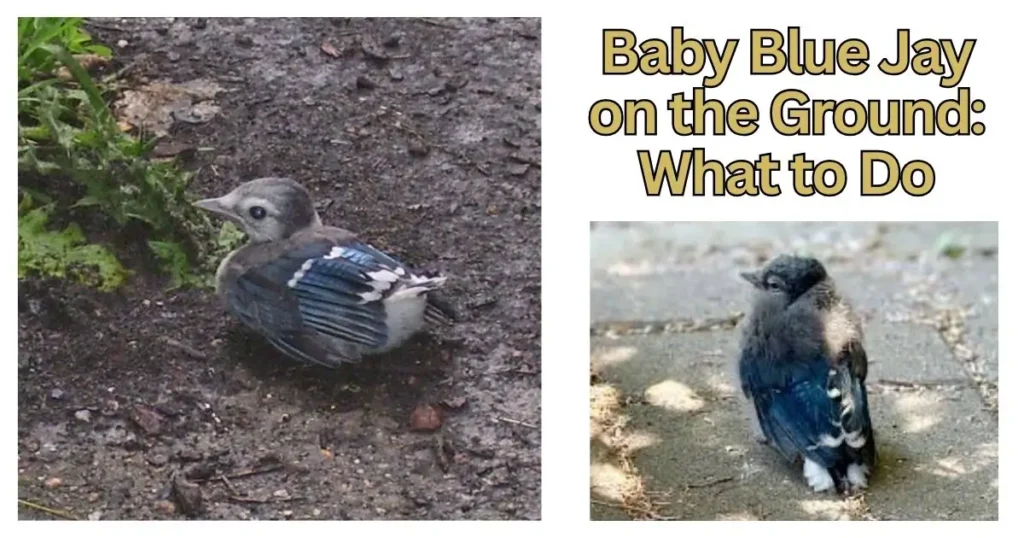
This is the most anxiety-inducing moment in backyard birdwatching, and it triggers more wildlife hotline calls than almost any other situation.
A baby Blue Jay on the ground is not necessarily an emergency. Here’s how to assess the situation accurately.
Step 1: Identify the Stage
The single most important question is whether the bird is a nestling or a fledgling:
- Nestling: Few or no feathers, eyes possibly closed, unable to grip or hop. These birds have fallen or been displaced before they should have left the nest.
- Fledgling: Mostly feathered, can grip a branch, short tail. This bird is supposed to be on the ground. The parents are almost certainly nearby, continuing to feed it.
Step 2: For Fledglings – Leave Them Alone
Important: The single most common mistake people make is “rescuing” a healthy fledgling. A fledgling Blue Jay on the ground or in low vegetation is normal.
The parents will feed it on the ground. Move pets and children away from the area and observe from a distance; you will almost certainly see an adult return within 15–30 minutes.
Step 3: For Nestlings – Attempt to Return to Nest
If you find a featherless or barely-feathered nestling, look for the nest above. If you can reach it safely, gently return the bird. The “hands will leave a scent” myth is completely false; birds have a poor sense of smell, and parents will not reject a handled nestling.
If the nest is inaccessible or destroyed, create a substitute: a small container (a plastic berry basket works well) lined with dry grass, attached to the original tree as close to the original nest height as possible. Monitor for adult return.
Step 4: Contact a Wildlife Rehabilitator
If the bird is injured, the parents have not returned after 2+ hours of careful observation, or the nestling cannot be safely returned to the nest, contact a licensed wildlife rehabilitator.
Do not attempt to raise a baby Blue Jay yourself. They have highly specific dietary and developmental needs, and in most states, it is illegal to hold a wild bird without proper permits.
Resource: Use the NWRA (National Wildlife Rehabilitators Association) finder at nwrawildlife.org or call your state wildlife agency to locate a licensed rehabilitator near you.
Are Blue Jays Protective of Their Nests? Nest Defense Behavior
Emphatically yes. Blue Jay nest defense is one of the most assertive in the songbird world. The same cognitive aggression that drives feeder dominance is redirected during nesting season toward protecting the clutch.
Documented nest defense behaviors include:
- Alarm-calling: Continuous, loud alarm calls that alert other birds in the area to the presence of a predator. Blue Jays function as a neighborhood early-warning system.
- Mobbing: Recruiting other Blue Jays and even other species to harass predators, particularly crows, hawks, and owls.
- Dive-bombing: Direct aerial attacks on mammals, including squirrels, cats, raccoons, and humans who approach too closely.
- Distraction displays: Drawing predator attention away from the nest by calling loudly from a distance.
If a Blue Jay is actively dive-bombing you in your own yard, you are almost certainly within 50 feet of an active nest. The behavior typically resolves on its own once fledglings disperse, usually within 2–3 weeks.
Practical Advice: If you are being mobbed by Blue Jays while doing yard work, simply wearing a hat provides meaningful protection and allows you to continue working. The adults are responding to your height profile as a predator threat, reducing your apparent size with a hat or crouching posture often reduces the intensity of mobbing behavior.
Daniel Carter
Frequently Asked Questions: Blue Jay Nesting
Q: How often do Blue Jays lay eggs?
Blue Jays typically produce one clutch per year of 3–6 eggs. If the first nest fails early in the season, the pair may attempt a second clutch. Two successful clutches in a single season are rare and typically occur only in southern states with long warm seasons.
Q: Do Blue Jays come back to the same nest every year?
Not reliably. Blue Jays may return to the same tree or territory in subsequent years, but they typically build a new nest rather than reusing the previous year’s structure. Old nests deteriorate over winter, and fresh construction is the norm. However, the same pair often nests within 100–200 feet of their previous year’s site.
Q: Where do Blue Jays roost at night?
Blue Jays roost in dense vegetation; thick evergreen trees are preferred for their wind and predator protection. During nesting season, the female roosts on the nest; the male typically roosts nearby in adjacent dense cover. Outside of nesting season, both sexes roost independently in sheltered tree cavities or dense branch structures.
Q: Do Blue Jays eat other birds’ eggs or babies?
Yes, occasionally. Blue Jays are omnivores and opportunistically raid the nests of other bird species, taking eggs and nestlings. This behavior is real, though ornithologists note it is far less common than popular belief suggests. Studies of Blue Jay stomach contents show plant material (seeds, nuts, berries) comprises over 75% of their diet. The reputation for nest predation exceeds the actual documented frequency.
Q: Can you move a Blue Jay nest?
Moving an active nest with eggs or young is strongly discouraged and, under most circumstances, illegal under the Migratory Bird Treaty Act. Blue Jays have a strong attachment to their nest site and will almost certainly abandon a moved nest. If a nest is in a genuinely problematic location (active construction, safety hazard), contact your state wildlife agency for guidance on legal options.
Q: What is a natural enemy of a Blue Jay?
Blue Jays face predation from Cooper’s Hawks and Sharp-shinned Hawks (aerial predators specifically adapted to pursue corvids through dense cover), Eastern Screech-Owls and Great Horned Owls (night roost threats), raccoons, squirrels, and domestic cats at the nest. Crows, a related corvid species, are persistent nest predators and trigger some of the most intense Blue Jay mobbing responses observed.
Q: Where do Blue Jays go in winter?
Blue Jays are partially migratory, with a complex and not fully understood pattern. Some individuals remain year-round residents; others migrate south in loose flocks in autumn.
Research suggests that migration behavior may vary by age and individual, with younger birds more likely to move.
Year-round populations are stable across the eastern US, and feeder activity typically increases in winter as natural food sources become scarcer.
Q: How long do fledgling Blue Jays stay with their parents?
Blue Jay fledglings remain dependent on their parents for food and guidance for approximately 4–6 weeks after leaving the nest. Family groups, both parents and the season’s young, often remain loosely associated into early autumn before young birds disperse to establish their own territories.
Final Thoughts: Watching Blue Jays Nest
Blue Jay nesting season runs on a compressed, intense timeline, from the first quiet courtship flights in March to fully independent fledglings by midsummer.
If you invest time in observing rather than intervening, you’ll see some of the most compelling family behavior in backyard ornithology: devoted pair bonds, shared nest-building, fierce nest defense, and the gradual, fascinating process of altricial young becoming fully capable birds.
The best thing most people can do during Blue Jay nesting season is exactly what birders do: observe quietly, keep cats indoors, reduce feeder disturbance near suspected nest sites, and resist the urge to help birds that don’t need helping. The parents know what they’re doing far better than we do.
And if a fledgling ends up on your lawn staring at you with those wide dark eyes, breathe. Step back. Watch from a distance. The family is almost certainly still together, playing out a story that’s been unfolding in the eastern forests of North America for millions of years.
Related Articles (Internal Links)
- Are Blue Jays Aggressive? The Truth About Feeder Bullying
- Blue Jay Diet: What Do Blue Jays Eat Season by Season?
- How to Attract Blue Jays to Your Yard
- Corvid Intelligence: Why Jays, Crows & Ravens Are the Smartest Birds
About the Author
Daniel Carter
Daniel Carter is a certified birding enthusiast with over 14 years of active field experience across the Eastern United States. He actively logs nest monitoring data and maintains year-round yard counts submitted to eBird and the Cornell Lab of Ornithology. When he’s not writing about search engines, he’s tracking fledgling cohorts through the back-forty with a 10×42 binocular and too much coffee.
Follow us on PINTEREST.